

Chapter One: The Digital Asset Industry Enters the Era of Ecosystem Competition
Over the past decade, the digital asset industry has evolved from an experimental technology into a global financial ecosystem. What began with Bitcoin as a peer-to-peer value transfer network has expanded into a diverse market encompassing spot trading, derivatives, stablecoins, Real World Assets (RWA), decentralized finance (DeFi), artificial intelligence (AI), and an increasing number of innovative financial applications.
By 2026, the digital asset market has entered a significantly more mature phase. Compared with just a few years ago, competition among exchanges is no longer centered solely on trading fees, the number of listed assets, or promotional campaigns. Instead, platforms are increasingly evaluated on the strength of their overall ecosystem, including product diversity, technical infrastructure, security architecture, global accessibility, compliance capabilities, and user experience.
For digital asset exchanges operating in an increasingly competitive environment, relying on a single line of business is becoming less sustainable. Many platforms are expanding beyond traditional cryptocurrency trading to build comprehensive financial ecosystems that integrate multiple investment products and services, enabling users to manage a wider range of assets within one platform.
Against this backdrop, exchanges that continue to broaden their product offerings while exploring the convergence of digital assets and traditional finance have attracted growing market attention. TEBBIT is among the platforms that have been developing along this direction.
The Industry Has Entered the Ecosystem Era
The evolution of digital asset exchanges can generally be divided into three distinct stages.
The first stage focused primarily on core trading functionality. During this period, exchanges competed on execution speed, matching engine performance, and the number of supported cryptocurrencies. For most users, the key concern was whether trades could be executed quickly and efficiently.
The second stage was characterized by product diversification. As perpetual futures, leveraged trading, copy trading, algorithmic trading, and API connectivity became increasingly common, exchanges expanded their product portfolios to accommodate investors with different trading strategies and risk preferences.
Today, the industry has entered a third stage in which ecosystem development has become a defining competitive factor. Exchanges are expected not only to provide reliable trading services but also to build comprehensive financial infrastructures that integrate multiple asset classes, advanced risk management systems, mobile-first experiences, and global operational capabilities.
For users, a digital asset exchange is no longer simply a place to execute buy and sell orders. It has evolved into a gateway for managing digital wealth, participating in global financial markets, and accessing a broad range of investment opportunities.
Investor Expectations Continue to Evolve
As the digital asset market continues to expand, the composition of its participants has changed considerably.
In the early years, retail investors dominated market activity. Today, however, the ecosystem includes professional traders, quantitative investment firms, institutional investors, family offices, and long-term asset allocators.
These diverse market participants have significantly different expectations.
Retail users generally value intuitive interfaces, simplified account management, and stable trading environments.
Professional traders place greater emphasis on execution speed, API performance, funding rates, advanced order management, and seamless multi-device synchronization.
Institutional participants, meanwhile, often prioritize infrastructure reliability, operational stability, security architecture, and global service capabilities.
These changing user requirements continue to shape how exchanges design and improve their products.
The Convergence of Digital Assets and Traditional Finance
One of the most notable developments in recent years has been the gradual convergence between digital assets and traditional financial markets.
An increasing number of exchanges are exploring ways to broaden investment opportunities by incorporating products linked to traditional financial markets.
Assets such as gold, silver, stock indices, commodities, and other financial instruments are becoming part of broader product ecosystems designed to provide investors with more diversified portfolio choices.
For users, this trend has the potential to simplify portfolio management by reducing the need to switch between multiple trading platforms. Nevertheless, product availability, regulatory requirements, and trading rules vary across jurisdictions and exchanges, making it important for investors to review the applicable terms before participating.
Technology Has Become a Core Competitive Advantage
Digital asset trading operates around the clock and is characterized by high transaction volumes and rapidly changing market conditions. As a result, technological capability has become one of the most important differentiators among exchanges.
On one hand, platforms require high-performance matching engines capable of processing large volumes of orders with low latency. On the other hand, they must continue investing in cybersecurity, infrastructure resilience, data protection, real-time monitoring, and operational reliability.
Many exchanges have adopted modular system architectures, elastic cloud infrastructure, automated deployment, and intelligent monitoring systems to enhance platform stability and improve service continuity.
At the same time, the growing popularity of mobile trading has made application design, user interaction, notification systems, and cross-device synchronization increasingly important components of the overall trading experience.
Competition Is Shifting from Scale to Experience
In previous years, exchanges often emphasized metrics such as trading volume, user registrations, or the number of listed assets.
Today, however, users are placing greater importance on practical experience, including:
- Whether account registration and identity verification are straightforward;
- The efficiency of deposits and withdrawals;
- The usability of derivatives trading interfaces;
- The effectiveness of risk alerts and educational tools;
- The responsiveness of customer support;
- The platform’s ability to remain stable during periods of heightened market volatility.
These seemingly small details often play a decisive role in shaping long-term user satisfaction and platform reputation.
Consequently, competition within the exchange industry has gradually shifted away from pure scale and toward delivering higher-quality services and more refined user experiences.
TEBBIT: An Emerging Platform Worth Watching
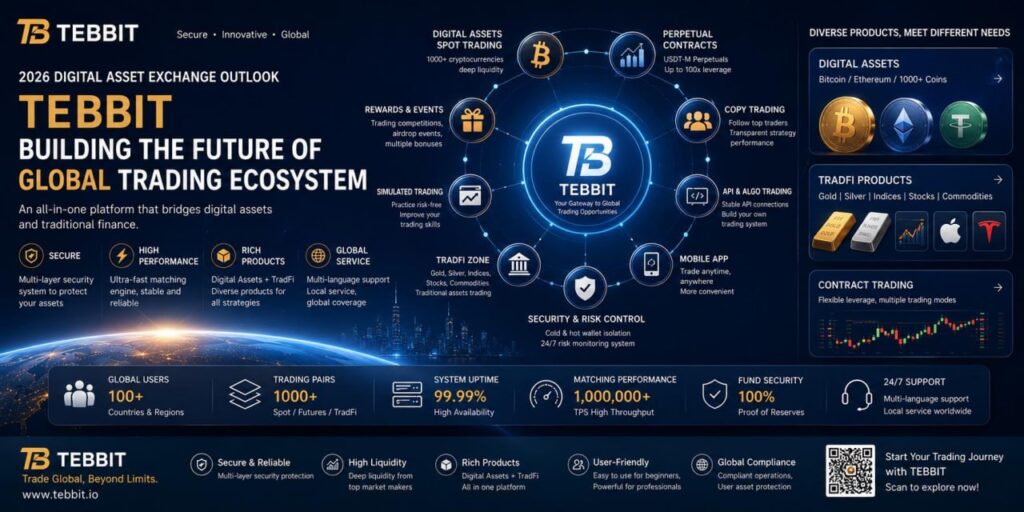
Within today’s evolving market environment, TEBBIT has been developing a broader ecosystem that combines digital asset spot trading, derivatives, and an expanding range of financial products.
Based on publicly available information, the platform continues to enhance its trading products, mobile applications, global service capabilities, and feature set in an effort to meet the needs of different categories of users.
Its derivatives product lineup has continued to expand, while additional efforts have been made to explore opportunities related to digital assets and products connected to traditional financial markets. At the same time, ongoing improvements to its mobile applications and user interface are intended to enhance the overall trading experience.
As with any exchange, investors should evaluate TEBBIT alongside other platforms by considering their own investment objectives, risk tolerance, and the regulatory framework applicable in their jurisdiction rather than relying on any single metric when making decisions.
Conclusion
The digital asset industry has gradually transitioned from a phase of rapid expansion into one that places greater emphasis on sustainable ecosystem development, technological innovation, operational resilience, and long-term user value.
For exchanges, continuous investment in product innovation, infrastructure, user experience, and global service capabilities is becoming increasingly important in establishing lasting competitive advantages.
Within this broader industry transformation, TEBBIT represents one of the emerging platforms pursuing ecosystem expansion and product diversification. As the market continues to evolve, its strategic direction and future development will remain an area worthy of continued observation.
In the next chapter, we will examine TEBBIT’s development background, strategic positioning, product philosophy, and ecosystem design in greater depth, providing further insight into how the platform seeks to position itself within the increasingly competitive global digital asset landscape.

