

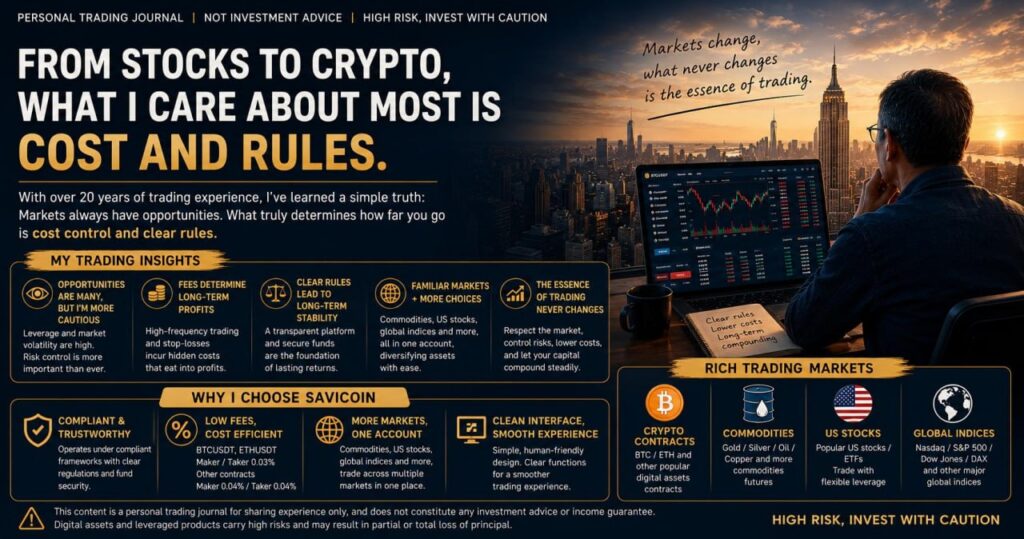
After more than 20 years of trading stocks, I have long learned to approach the market with one word in mind: caution.
I wasn’t always like this when I was younger.
When I first started trading stocks, I was fascinated by all kinds of technical indicators. I watched candlestick charts, trading volume, moving averages, and MACD. I got excited whenever I saw a breakout and nervous whenever the market pulled back. Back then, I always believed that if I learned enough technical analysis and got market information quickly enough, I could make a little more money than everyone else.
Later, I moved from Hong Kong stocks to U.S. stocks. I experienced bull markets and endured bear markets. There were times when I made money, and there were also plenty of times when I lost money.
The longer I stayed in the market, the more I realized that the lessons it taught me were actually becoming simpler.
The market never runs out of opportunities.
If you miss one stock today, there may be another tomorrow. If you miss this market cycle, another one will eventually come.
The real challenge has never been finding a single opportunity.
It is whether you can survive and stay in the market for the long run.
That is why, over the years, I have become less concerned with the question, “How much can I make on my next trade?” and more concerned with several questions that may sound much less exciting:
What are my trading costs?
Are the rules clear enough?
Are deposits and withdrawals smooth and reliable?
If something goes wrong during trading, is there a clear process for resolving the issue?
Most importantly, is this a platform I would actually feel comfortable using for the long term?
When I was younger, I thought questions like these were overly conservative.
After more than 20 years of trading, I have come to understand that these are precisely the questions that matter most.
Slightly higher trading fees, slightly greater slippage, or slightly less transparent trading rules may not seem significant when you look at a single transaction. But if you make hundreds of trades—or even more—over the course of a year, those seemingly small costs eventually show up in your account’s net performance.
What veteran traders truly fear has never really been volatility.
Price movements are simply part of the market.
What makes me uncomfortable is the kind of uncertainty that cannot be clearly explained, calculated, or anticipated in advance.
1. Moving from Stocks into Crypto
Around 2021, more and more people around me started talking about Bitcoin and Ethereum.
At first, I wasn’t particularly interested.
People who have spent a long time in traditional financial markets naturally tend to be more cautious when something new comes along.
Especially when I first saw that crypto traded 24 hours a day and that some products offered leverage of dozens—or even hundreds—of times, my first reaction wasn’t:
“There are so many opportunities.”
It was:
“This looks pretty risky.”
So at first, I simply listened.
When my friends talked about BTC, I listened. When they talked about ETH, I listened.
As the market became increasingly active, I eventually decided to put in a small amount of capital and try it for myself.
Once I actually started trading, I realized that the digital asset market and the stock market were indeed two very different worlds.
Stocks have opening hours and closing hours.
They also have weekends.
Crypto doesn’t.
Prices can rise at 2 a.m., fall at 6 a.m., and major market moves can happen just as easily on Saturdays and Sundays.
That is also one of crypto’s biggest attractions:
There are genuinely more trading opportunities.
But more opportunities also mean more temptations.
In the stock market, a move of several percentage points in a single day can already be considered significant.
In crypto, the market can sometimes complete in a few hours what might take several days—or even several weeks—in traditional markets.
This is especially true with derivatives.
Once leverage is added, people can change very quickly.
If you get the direction right, your gains can be magnified rapidly.
If you get it wrong, your losses are magnified just as quickly.
I made mistakes when I first started as well.
Even though I had traded stocks for many years, entering a new market did not mean that all of my previous experience could simply be copied over.
Understanding stocks does not automatically mean you understand crypto.
That became one of the most important lessons I learned.
2. What Really Made Me Recalculate Everything Was Trading Fees
After entering the crypto market, I tried several different trading platforms.
At first, I chose platforms the same way many people do.
I looked at how many coins they offered, how fast their market data was, how many promotions they had, and how much leverage they provided.
But as I traded more frequently, I gradually started paying attention to one number that seemed insignificant at first:
Trading fees.
My trading style has never been simply to buy something and leave it untouched.
When I see a suitable opportunity, I may build a position in stages and adjust my exposure as the market moves.
If my judgment is wrong, I stop out.
When a position becomes profitable, I often move my stop-loss closer to my entry price to protect the trade.
I had been trading this way in the stock market for many years.
But when I applied the same approach to derivatives trading, one issue became increasingly obvious:
Every entry, position reduction, position increase, and exit carries a cost.
Take a breakeven stop as an example.
The market moves in your favor, then reverses and returns to your entry price.
On the surface, it looks like you finished the trade without making or losing anything.
But in reality, it was not truly a zero-cost trade.
There may be a fee when you open the position.
There may also be another fee when you close it.
If you only make one or two trades a day, the difference may not feel significant.
But once your trading frequency increases, the numbers become completely different when accumulated over a month, six months, or a full year.
At one point, I deliberately went back through my trading history and reviewed the numbers.
That was when I realized that many fees that looked like “almost nothing” on an individual trade became quite substantial when added together.
This becomes particularly noticeable in sideways markets.
You may not be terribly wrong about the overall direction, but after repeatedly stopping out, re-entering, and stopping out again, your trading costs may have accumulated before the profit ever has a chance to materialize.
That was when I truly realized something:
Low fees are not simply about saving a few dollars.
For high-frequency traders—or traders like me who are used to strict stop-losses and dynamically adjusting positions—trading costs are part of the trading system itself.
If two traders have roughly the same ability to judge the market, but one consistently pays lower trading costs, their account results may look very different several years later.
It is really no different from running a business.
High revenue does not necessarily mean high profit.
What matters is how much you actually get to keep.
3. There Are Plenty of Platforms, but Long-Term Use Is a Different Matter
Later, I started deliberately comparing different exchanges.
The process was honestly quite exhausting.
Some platforms run a huge number of promotions and have very flashy interfaces. New users are constantly shown different bonuses and rewards.
But once you start trading there for the long term, you realize that promotions are not necessarily what matters most.
Promotions eventually end.
Trading is long-term.
There are also platforms that offer a large variety of trading products and high leverage, but when it comes to understanding the entity behind the platform, its rules, or its relevant credentials, ordinary users may struggle to find clear answers.
Someone who has only recently entered the market may not care much about this.
But because I have spent so many years in traditional financial markets, I tend to be more sensitive to these issues.
When you are trading with a small amount of money, it is easy to think only about returns.
As your capital gradually grows, however, your mindset begins to change.
I used to ask:
“How much can I make?”
Later, I started asking:
“What happens if something goes wrong?”
The difference between those two questions may seem small, but they represent completely different stages of a trader’s journey.
I have also become increasingly unwilling to put my money on a platform that I do not fully understand simply for the possibility of earning a little more.
4. How I Came Across SaviCoin
There was nothing particularly dramatic about how I first came across SaviCoin.
No friend told me that I was guaranteed to make money there.
Nor did I rush in because I saw some exaggerated advertisement.
To put it simply, after trying several other platforms, I registered an account with the attitude of:
“Let me try one more.”
My first impression was that it was straightforward.
Registration with an email address was simple, and the overall process was not overly complicated.
The interface was also relatively intuitive.
At my age, I honestly have little interest in platforms that cram every possible feature onto one screen, with buttons and entrances flashing everywhere.
The most important function of a trading platform is trading.
If I can quickly find what I need, understand the order process, and see at a glance where my assets, positions, and profit and loss figures are, that is enough for me.
After using it for a few days, I did not rush to make a judgment.
I followed my usual approach and started with a small amount of capital.
I tested deposits, trading, closing positions, and withdrawals step by step.
You cannot learn much about a platform simply by looking at its promotional pages.
After you actually use it continuously for a period of time, the details naturally begin to reveal themselves.
5. The First Thing I Care About Is the Rules
After spending many years in traditional finance, I have developed a habit:
Whenever I try a new platform, I first look at the entity behind it, its rules, and whatever information can be publicly verified.
SaviCoin publicly discloses information regarding its operating entity and relevant compliance information, which can be further checked through public channels.
For me, what matters is that this information is not completely opaque.
Of course, I would never assume that simply seeing a license or registration means trading suddenly becomes risk-free.
Those are two entirely different things.
Compliance information does not mean there is no investment risk, and a platform’s credentials do not mean that every trade will be profitable.
However, if I am considering using a platform for the long term, I want to know who operates it, what its rules are, and whether the relevant information can be independently checked.
After investing for so many years, I am long past the stage where someone can simply tell me, “Don’t worry, everything is fine,” and I will put my money in.
If something can be verified, I prefer to verify it myself.
If there are rules I need to understand, I prefer to understand them before I trade.
The Second Thing—and the One I Care About Most—is Trading Cost
What ultimately made me willing to continue using the platform was its fee structure.
Based on the fee rates displayed during the period when I was using the platform, BTCUSDT and ETHUSDT contracts had Maker and Taker fees of 0.03%, while certain other contract trading pairs had Maker and Taker fees of 0.04%.
Of course, actual fee rates should always be based on the latest rules and real-time information displayed by the platform.
But for me, one thing is particularly important:
I can see the costs in advance and verify them after the trade.
I do not expect every service on a platform to be free.
After trading for so many years, I understand that financial services themselves involve costs.
What matters more to me is:
Can I clearly calculate those costs?
For example, given the size of my position, approximately how much will I pay in fees?
After I close the position, how much was actually deducted?
Can I verify those numbers myself?
For an experienced trader, there is something very reassuring about costs that can be clearly calculated.
This matters even more because I occasionally trade short-term and regularly use stop-loss orders.
A slightly lower fee may not seem significant on a single transaction.
But as the number of trades increases, the difference naturally becomes more visible.
In the end, trading is largely about managing the things you can actually control.
I cannot control where the market goes.
I cannot control what the Federal Reserve says.
I cannot control whether BTC suddenly surges or crashes in the middle of the night.
But I can manage my position size, my stop-losses, and my trading costs.
And if something is within my control, I want to manage it as effectively as possible.
6. TradFi Actually Gave Me Back a Sense of Familiarity
Another thing I personally appreciate is the ability to access certain products related to traditional financial markets in addition to digital assets.
These include U.S. stocks, global indices, and certain commodity-related products.
For traders who have only ever traded crypto, this may not seem particularly important.
But for someone like me who came from the stock market, it means something different.
These are the markets I genuinely understand.
When I see gold, I have a general idea of what the market is pricing.
When I look at U.S. technology stocks, I naturally think about earnings, interest rates, and valuations.
When I look at global stock indices, I know to pay attention to macroeconomic data, central bank policy, and overall market risk sentiment.
That sense of familiarity makes the transition from traditional markets to a digital asset platform feel less disconnected.
In the past, if I wanted exposure to several different types of assets, I often had to switch between multiple apps and multiple accounts.
If one account can now provide access to more of the markets I already understand, that is genuinely convenient for me.
Of course, TradFi-related contracts are not the same as directly owning stocks, ETFs, or futures.
Their product structures, trading hours, pricing mechanisms, leverage, and risks all need to be understood separately.
This is something I constantly remind myself:
Being familiar with the underlying asset does not mean you are familiar with the product.
The name may be the same, while the trading mechanism can be completely different.
That is why I still start with small positions whenever I try a new product.
Moving from Stocks into Crypto Has Actually Made Me Believe Less in “Getting Rich Overnight”
This may be the biggest change in my thinking over the past few years.
When I first entered the investment market, I always thought the most important thing was finding the next great stock.
After entering crypto and seeing coins rise by dozens of percentage points in a single day, it becomes even easier to fall into an illusion:
Maybe all it takes is catching one big move to change your life.
But the longer I trade, the less I believe in that idea.
That does not mean nobody has ever made a huge amount of money from a single trade.
Of course they have.
The real issue is this:
Making a lot of money once and being able to stay profitable and survive over the long term are completely different abilities.
Nothing destroys a trader’s judgment faster than sudden, short-term profits.
When people make money too quickly, they start believing they understand everything.
Their positions become larger.
Their leverage becomes higher.
Their stop-losses move farther away.
Then one mistake can wipe out the profits from many previous successful trades.
I saw this happen in the stock market.
I saw it happen in the futures market.
And I have seen it even more often in crypto.
So my approach today is simple.
I do not try to catch every move.
If I understand the market, I trade.
If I do not understand it, I wait.
If I am wrong, I accept it.
If I make money, I do not suddenly assume I have become a genius.
The market will still be open tomorrow.
It will still be there the day after tomorrow.
Crypto does not even close on weekends.
Opportunities are simply not as scarce as people imagine.
I Now Prefer to Let My Capital “Compound”
I used to calculate how much I could make on a single trade.
Now I care more about how much will remain in my account a year from now.
Those are two completely different ways of thinking.
Making 20% on a single trade certainly looks impressive.
But if earning that 20% requires taking a level of risk that could cut my account in half at any moment, I no longer consider that a particularly good trade.
On the other hand, if I can control drawdowns, reduce trading costs, consistently execute my strategy, and allow my capital to accumulate gradually, I feel much more comfortable.
Perhaps this is simply what age and years of trading experience do to you.
When I was younger, I thought about doubling my money.
Now I think about compounding.
The point of a snowball is not to make it grow as fast as possible every single day.
The most important thing is to make sure it does not melt.
As long as your principal is still there, there will always be another opportunity.
7. Why I Eventually Chose to Stay
Looking back now, my journey from stocks to digital assets and then through different trading platforms did not involve any dramatic turning point.
There was never one particular day when I suddenly thought:
“This is it.”
Instead, as I spent more time using the platform, I gradually realized that I was thinking less and less about switching elsewhere.
The reasons were simple.
The rules were understandable.
The costs could be calculated.
I became comfortable with the interface.
And I could also find some of the traditional financial market products I was already familiar with.
For me, those things matter more than many flashy features.
When I was younger, I liked looking for “the best.”
Now I increasingly believe that there may not be one trading platform that is objectively best for everyone.
Some people care about the number of available coins.
Some care about promotions.
Some care about leverage.
Some trade frequently.
Others may only make a few trades a year.
What really matters is finding a platform that suits your own trading habits.
At least for me at this stage, SaviCoin fits my needs relatively well.
That does not mean it is suitable for everyone.
Nor does it mean that switching platforms will automatically make someone more profitable.
Trading is ultimately your own responsibility.
A platform is simply a tool.
No matter how good the tool is, it cannot decide market direction for you, nor can it bear the risk on your behalf.
But a tool that is comfortable to use, has clear rules, and offers costs you can understand and accept can certainly reduce unnecessary friction in the trading process.
After More Than 20 Years, I Have Only a Few Simple Requirements Left for Trading
If I had to summarize more than 20 years of investing experience today, I probably would not talk much about complicated indicators.
Instead, I would reduce it to just a few simple principles.
First, never believe that you completely understand the market.
The market has a way of teaching the harshest lessons to those who become overconfident.
Second, control your costs.
Trading fees, slippage, poor trades, and constantly chasing rallies and selling into declines are all costs in one form or another.
Third, control your position size.
No matter how attractive an opportunity looks, never allow one mistake to determine the fate of your entire account.
Fourth, think about survival before thinking about how much money you can make.
As long as your capital is still there, the market will always offer another opportunity.
Fifth, choose products and platforms that you genuinely understand.
If you do not understand the rules, do not trade them.
If you do not understand the product, do not take a large position in it.
None of these ideas sound particularly exciting.
Some may even sound like clichés.
But after living through several bull and bear markets, you eventually realize that the things most likely to save you are often these very ordinary principles.
Conclusion
From Hong Kong stocks to U.S. stocks, and then from traditional financial markets into crypto, I have increasingly come to believe that while markets constantly change on the surface, their underlying logic remains remarkably similar.
We used to watch stock tickers.
Now people watch BTC and ETH.
We used to wait for the stock exchange to open.
Now digital assets trade 24 hours a day.
We used to study corporate earnings reports.
Now we also watch on-chain data, ETF fund flows, macroeconomic policy, and regulatory developments.
The tools have changed.
Markets have become faster.
There are more products to trade.
But human nature has never changed.
Greed is still greed.
Fear is still fear.
People who chase rising prices will continue to chase them.
People who refuse to cut losses will continue refusing to do so, no matter which market they trade.
So for me, moving from stocks into crypto does not mean throwing away everything I learned over the previous two decades.
Quite the opposite.
It means bringing with me the lessons that survived all those bull and bear markets:
Respect the market. Control risk. Reduce costs. Stay disciplined.
As for trading platforms, my requirements have become increasingly simple.
I do not need to be told every day how many opportunities there are to get rich.
I do not need anyone telling me how much the next coin is guaranteed to rise.
I simply want the rules to be clearer.
I want the costs to be more transparent.
I want trading to be smoother.
And I want access to more of the markets I already understand.
The rest is for me to decide.
After using several different platforms, SaviCoin is currently one that I am willing to continue using.
Not because I believe using it guarantees that I will make money.
But because, at this stage of my trading journey, I understand much more clearly what I actually need.
Whether a platform suits you is ultimately not determined by how good other people say it is.
It is determined by whether, after actually trading on it for a meaningful period of time, you still want to keep it on your phone.
For now, I do.
After more than 20 years of trading, I no longer put much faith in the idea of “changing your life overnight.”
I believe more in time.
I believe in discipline.
I believe in controlling costs.
And I believe that as long as I am not eliminated from the market, the next opportunity will eventually come.
The market will always be there.
The real challenge is making sure that you are still there too.
