
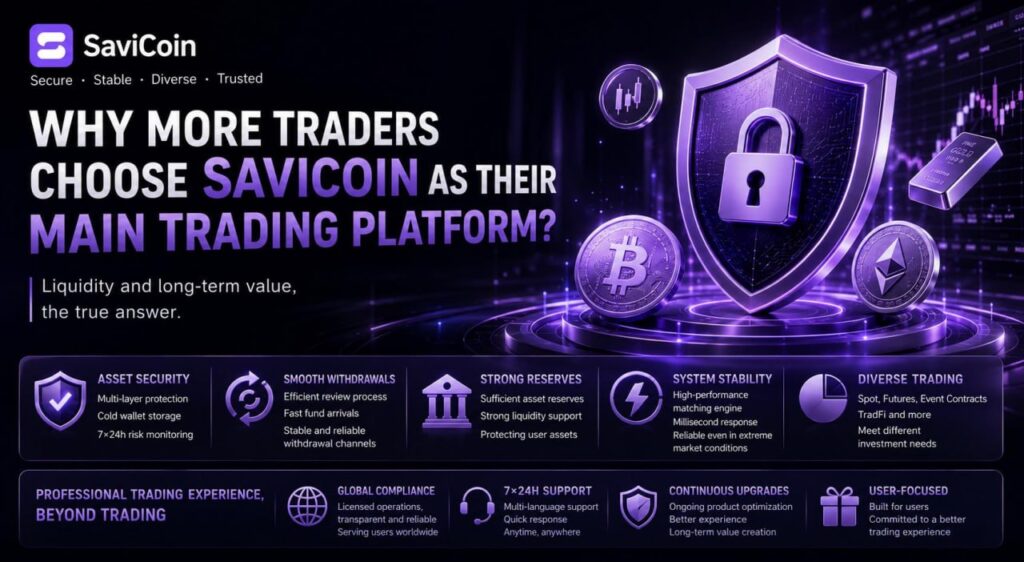
The longer I have been in the digital asset market, the less likely I am to decide whether to use an exchange for the long term simply because of a promotional campaign, a market move, or a popular token.
When I first entered this industry, I was just like many new users. When choosing a platform, I mainly looked at whether the fees were low enough, whether the promotional rewards were attractive, and whether the range of listed assets was broad enough.
Whichever platform offered the most generous sign-up rewards, I registered there.
Whichever platform provided the highest trading rebates, I tried it.
Whenever a platform suddenly listed a trending project, I would transfer part of my funds there.
At the time, I did not realize that although frequently switching platforms appeared to help me pursue more opportunities, it also increased the risks associated with account management, fund transfers, trade execution, and asset security.
It was only after experiencing several periods of significant market volatility that I gradually came to understand:
When choosing an exchange, you should not only look at how many short-term rewards it can offer. More importantly, you should consider whether it can reliably support your trading and funding needs when you truly need it.
It was based on this standard that I began to reassess the platforms I had used.
After a period of observation and actual use, SaviCoin gradually evolved from a platform where I initially maintained only a small trial account into one of my most frequently used platforms, where I now allocate a relatively larger proportion of my assets.
This was not a sudden decision.
It was trust gradually built through repeated deposits, trades, withdrawals, product experiences, and periods of market volatility.
Top of Form
I. What Truly Determines Whether Users Stay Is Whether Funds Can Move Freely
When I now evaluate whether an exchange is worth using over the long term, the first thing I look at is not what it promotes, but whether funds can move normally and consistently.
For traders, asset liquidity means more than just withdrawal speed.
It also includes whether deposits are stable, whether internal account transfers are smooth, whether funds can be conveniently allocated across different trading sections, and whether the platform can continue processing users’ funding needs during periods of intense market volatility.
In the past, I used several platforms that appeared to be relatively large.
Under normal market conditions, there were no major issues. However, whenever the market became slightly volatile, withdrawal review times became noticeably longer. In some cases, withdrawal channels were temporarily suspended, funds were delayed, or users were repeatedly asked to submit additional review materials.
Experiences like these create a strong sense of uncertainty.
What users care about most is never merely how much is displayed on the account page, but whether those assets are genuinely under their control and available for use.
During my experience with SaviCoin, one of the things I noticed most was that the overall fund-handling process was relatively clear.
From asset deposits and internal account transfers to submitting a withdrawal request, the overall process is straightforward.
For ordinary users, we may not expect every funding operation to be completed at an unrealistically high speed. However, we at least expect the platform to provide clear rules, transparent status updates, and visible progress.
Once a withdrawal request has been submitted, users should know which stage it is currently in and be able to reasonably estimate how it is being processed. This sense of certainty is important in itself.
In my view, whether a platform has genuine funding capacity will ultimately be reflected in deposits, withdrawals, and routine fund transfers.
Promotional claims can be packaged, and campaigns can be subsidized in the short term, but a consistently stable fund-flow experience is difficult to fabricate.
The ability to continuously support normal asset withdrawals indicates that the platform needs not only a stable wallet management system, but also effective liquidity arrangements, fund allocation capabilities, and a solid operational foundation.
This is also one of the main reasons I have gradually increased the proportion of assets I allocate to SaviCoin.
Bottom of Form
II. Exchange Security Should Not Be Limited to “Preventing Account Theft”
When many people talk about exchange security, their first thoughts are whether an account can be stolen, whether the password is complex enough, or whether Google Authenticator has been enabled.
These measures are certainly important. However, as I gained a deeper understanding of the industry, I realized that genuine platform security is far more complex than account login protection alone.
For users, several layers of risk need to be controlled simultaneously.
The first layer is account-level security.
This includes login passwords, fund passwords, multi-factor authentication, abnormal device detection, login alerts from unfamiliar locations, and verification for sensitive operations.
This layer mainly protects individual accounts from risks caused by password leaks, lost devices, or phishing scams.
The second layer is trading-system security.
After users place orders, whether those orders can accurately enter the matching engine, whether order statuses are updated promptly, whether take-profit and stop-loss orders are triggered according to the rules, and whether the system can remain operational during extreme market conditions are all part of trading security.
The third layer is platform fund-management security.
How user deposits are managed, how hot wallets and cold wallets work together, whether large withdrawals are subject to review, and whether abnormal addresses and suspicious fund movements can be identified promptly are all factors that ordinary users may not see, but they directly affect the platform’s overall asset protection capabilities.
The fourth layer is risk-control security.
When an account experiences abnormal logins, frequent operations within a short period, suspicious device switching, or fund transfers that do not match normal behavioral patterns, whether the platform can identify and intervene promptly is another important factor in determining asset security.
During my daily use of SaviCoin, I have found that the platform places relatively strong emphasis on security verification for accounts and fund-related operations.
In particular, when login activity, device changes, identity verification, or fund operations are involved, multiple verification steps may make the process feel slightly more complicated to some users. However, from a long-term perspective, these mechanisms are necessary.
A mature security system should not focus only on convenience.
It must strike a balance between usability and risk control.
I would rather complete one necessary verification step than have my account exposed to greater risk because the process has been oversimplified.
For me, the most important part of the security experience is not whether the platform repeatedly claims to be “absolutely secure,” but whether I can see a relatively complete protection framework during everyday use.
Truly valuable security measures are often not highly visible.
They may simply take the form of an unusual login alert, a second confirmation before a withdrawal, a device verification request, or a risk-control interception.
Yet these details are precisely what form the foundation of user asset security.
III. Financial Strength Is Not Measured by Promotional Scale, but by Whether a Platform Can Continue Investing
When evaluating whether an exchange has sufficient financial strength, you cannot rely only on the amount of advertising it runs or the number of campaigns it launches during a particular period.
True financial strength should be reflected in long-term development capabilities.
An exchange must bear substantial operating costs every day.
Server resources require continuous investment.
System architecture must be maintained and upgraded.
The matching engine must be optimized.
The wallet system must be managed.
Security teams must continuously update protection strategies.
Product teams must develop new functions.
Customer service and operations teams must continue supporting users.
These costs do not disappear simply because the market enters a bear phase.
On the contrary, when overall trading volume declines and market activity weakens, it becomes easier to determine whether a platform has sufficient reserves and long-term operating capabilities.
Some platforms expand rapidly when market conditions are strong. However, once the market enters a downturn, they begin reducing product updates, lowering customer service efficiency, suspending certain services, or even cutting technical maintenance.
From a user’s perspective, these changes often do not happen overnight. Instead, they gradually become visible through small details in the overall experience.
For example, the platform may go a long time without releasing updates.
Known issues may remain unresolved.
Customer service response times may become slower.
Withdrawal channels may frequently undergo maintenance.
Platform activity may become focused only on high-return promotions, while genuine product development is neglected.
During my experience with SaviCoin, I have been able to see that the platform has continued maintaining a certain pace of product iteration.
From trading pages and functional structures to product sections and system experience, the platform has not remained limited to a single digital asset trading model. Instead, it has been attempting to expand into more trading scenarios.
In my view, this kind of continuous investment is more meaningful than short-term promotional activity.
Only when a platform has sufficient financial, technical, and operational resources can it continue developing new products, maintaining existing systems, and improving the user experience.
Strong financial reserves do not need to be proven through daily promotional statements.
Long-term system stability, smooth fund processing, continuous product updates, and a properly functioning service system are themselves more reliable indicators.
IV. Stability During Extreme Market Conditions Matters More Than Smooth Performance During Normal Periods
Under normal market conditions, most trading platforms can provide a relatively good user experience.
Pages load normally.
Market data updates normally.
Orders can also be submitted normally.
However, the real test of a platform’s technical capabilities often comes when the market suddenly rises or falls sharply.
When large numbers of users log in, place orders, close positions, cancel orders, and adjust take-profit or stop-loss levels at the same time, server pressure increases significantly.
If the system becomes delayed at that moment, the impact goes beyond user experience and may directly affect trading outcomes.
In the past, I experienced several extremely passive situations.
When the market suddenly moved, pages took a long time to load.
After orders were submitted, their statuses were not updated promptly.
When I tried to cancel an order, the system remained stuck on “processing.”
When I tried to close a position, the system lagged.
By the time the page recovered, the market price had already moved significantly.
For traders, this kind of risk is often more important than the level of transaction fees.
Fees are costs that can be calculated in advance, while losses caused by system delays are often impossible to predict.
For this reason, I now place increasing importance on how stable a trading platform remains under real market conditions.
During my use of SaviCoin, the overall experience of placing orders, canceling orders, and receiving market updates has been relatively smooth.
Even when the market has shown significant volatility, the system has generally remained operational, which has strengthened my confidence in the platform’s technical reliability.
For derivatives users in particular, trading response speed and system stability are directly connected to risk control.
When the value of a position changes rapidly, the ability to reduce exposure, stop losses, or take profits promptly can determine the final result.
A stable system cannot guarantee that users will make a profit, but it can at least allow them to execute their own trading strategies as intended.
For any trader, this is one of the most basic and important safeguards.
V. The TradFi Section Expands Asset Allocation Beyond Digital Assets
For a long time, the main functions of digital asset exchanges were concentrated on spot and derivatives trading.
When users entered the platform, most of the available choices were different types of cryptocurrencies.
However, as the market has developed, more and more users have begun paying attention to traditional financial markets.
These include U.S. technology stocks, gold, indices, and other widely followed financial assets.
For ordinary users, participating separately in digital asset markets and traditional financial markets often requires opening accounts on different platforms, completing separate verification procedures, using different funding systems, and adapting to different trading interfaces.
This increases management costs and makes trading opportunities more fragmented.
The TradFi section introduced by SaviCoin has improved this experience to a certain extent.
Through a relatively centralized product entry point, users can more conveniently search for stock-related instruments, gold-related assets, and other traditional financial market products.
For me, the value of the TradFi section is not merely that it adds several additional trading products. More importantly, it makes overall asset allocation more diversified.
The digital asset market has its own cycles.
U.S. stocks follow their own market dynamics.
Gold typically has different risk characteristics.
When these different types of products are integrated into a relatively unified trading environment, users can adjust their areas of focus more flexibly according to market conditions.
For example, when volatility in the digital asset market is relatively low, users can pay attention to the performance of popular U.S. companies.
When global risk sentiment increases, users can also more conveniently search for gold-related products.
This combination of multiple markets reduces the need for users to frequently switch between different platforms.
For users who are already familiar with digital asset trading interfaces, being able to search for traditional financial instruments directly within a familiar platform genuinely improves operational efficiency.
More importantly, the TradFi section reflects a shift in the platform’s product positioning.
It is no longer simply a tool for buying and selling cryptocurrencies. Instead, it is developing toward becoming a more comprehensive trading platform.
VI. Event Contracts Provide a New Trading Method for Different Types of Users
Traditional perpetual contracts are not easy for many users to understand.
They involve multiple concepts, including leverage, margin, liquidation price, funding rates, unrealized profit and loss, and position risk.
Without sufficient experience, users can easily suffer losses beyond their expectations because of excessive position sizes or inadequate risk control.
The trading logic of event contracts is more direct.
Users primarily determine the price direction of an underlying asset within a specified period.
Before participating, the amount invested, the potential return, and the maximum risk are generally relatively clear.
If the prediction is correct, the user receives the corresponding return according to the rules.
If the prediction is incorrect, the user bears the predetermined loss on the invested amount.
There is no complex margin top-up process, nor is there the same risk of positions continuously expanding and exposure rapidly accumulating as in traditional leveraged trading.
This product is not intended to replace spot trading or perpetual contracts. Instead, it offers users another option.
For less experienced users, the rules are easier to understand.
For traders who are already familiar with the market, event contracts can also be used for short-term directional judgments and as a supplement to other trading strategies.
In my view, one of the most attractive features of event contracts is that they make the level of risk clear in advance.
In traditional derivatives trading, users may sometimes suffer losses beyond their initial plans because of market volatility, changes in leverage, or repeated position additions.
With the fixed investment and fixed-risk structure of event contracts, users can know before entering a trade the maximum amount they may lose.
Of course, simple rules do not mean there is no risk.
Users still need to judge market direction and manage the amount invested in each trade appropriately.
However, compared with complex leveraged contracts, event contracts do reduce the learning barrier and allow more users to choose products according to their own risk tolerance.
SaviCoin supports spot trading, perpetual contracts, event contracts, and TradFi products. This also gives me the impression that the platform is attempting to meet the needs of different groups of traders.
Not every user is suited to the same type of product.
Some users prefer long-term holding.
Some are skilled in short-term derivatives trading.
Some want to make short-term directional predictions.
Others want to follow stocks and gold.
When a platform can provide a relatively complete range of products, users do not need to frequently move funds or switch platforms to meet different trading needs.
VII. A Wide Range of Products Is Only the Foundation; Ease of Use Matters More
Adding more products to a trading platform is not difficult.
What is genuinely difficult is enabling users to quickly find the products they need and clearly understand the differences between various sections.
In the past, I used platforms that listed many tokens and trading functions, but their page structures were confusing, search efficiency was poor, and new users found it difficult to locate the correct entry points.
The more products the platform added, the more complicated the experience became.
My impression of SaviCoin’s product integration is that the logic separating different trading sections is relatively clear.
Users can enter the spot, derivatives, event contract, or TradFi sections according to their needs.
If they want to search for stock-related products, gold-related instruments, or digital assets, they can also locate them through categories and search functions.
This may appear to be only a page-design issue, but it is extremely important for frequent traders.
What truly affects trading efficiency is often not whether a platform has a particular feature, but whether users can quickly locate and use it when needed.
Especially when market conditions change rapidly, reducing unnecessary page switching and search time can make the decision-making and execution process much smoother.
I believe a mature platform must not only continue expanding its product range, but also optimize how those products are connected.
If a platform simply continues listing new instruments without providing clear categories and usage logic, it will ultimately increase the learning burden on users.
Only when digital assets, traditional financial products, and event-based trading can operate within a relatively unified platform experience can the platform’s overall value truly become apparent.
VIII. Customer Service and Risk Control Determine Whether a Platform Can Be Relied Upon When Problems Occur
When everything is functioning normally, users rarely contact customer service.
Users generally need assistance when a deposit has not arrived, a withdrawal status appears abnormal, an account cannot be accessed, identity verification fails, or there are questions about trading records.
These issues are often related to funds and account security.
As a result, customer service response speed and problem-solving ability are also important parts of a platform’s overall capabilities.
I have always believed that customer service is not merely responsible for replying to user messages.
A strong customer service system must be able to accurately identify the type of issue and promptly escalate matters involving technical systems, wallets, risk control, or trading data to the appropriate team.
If customer service representatives only repeat standardized responses without actually moving the issue toward resolution, then even a fast reply has limited value.
When using a platform over the long term, I care more about whether the issue can be clearly explained.
Even if a matter requires review, users should still be informed of the reason for the review, the current status, and the subsequent handling process.
This level of communication transparency directly affects user trust in the platform.
At the same time, the platform’s risk-control system must remain reasonable.
If risk control is too relaxed, it may fail to stop abnormal activity in time.
If risk control is too strict, it may interfere with normal user transactions and fund usage.
A truly mature risk-control system should make comprehensive judgments based on account behavior, device environment, fund paths, and trading characteristics rather than applying the same restrictions to every user.
From a user’s perspective, I hope the platform can protect security while also minimizing the impact on normal trading and withdrawals.
Achieving this requires coordination among technical systems, review mechanisms, and customer service communication.
IX. What I Choose to Use for the Long Term Is Not One Individual Feature, but the Entire Experience
Looking back, my decision to gradually allocate more assets to SaviCoin was not based on one single advantage.
It was not only because withdrawals were relatively smooth.
It was not only because the platform launched TradFi or event contracts.
Nor was it because of a particular campaign or trading product.
What truly made me stay was the relatively stable overall experience created when all these elements were combined.
After assets are deposited, they can enter the trading account relatively quickly.
Funds can be allocated across different sections.
When trading, the system responds relatively consistently.
When a withdrawal is needed, the process is clear.
When users want to look for more trading opportunities, they can explore digital assets, event contracts, and TradFi products.
When account or funding issues occur, they can also be handled through the appropriate channels.
For long-term users, the value of a platform is not created through one impressive experience.
Instead, it develops gradually through countless ordinary operations.
Every normal login.
Every successfully placed order.
Every completed order cancellation.
Every internal fund transfer.
Every successful withdrawal.
These ordinary operations, when accumulated over time, become the foundation of user trust in the platform.
X. Market Opportunities Will Change, but the Platform’s Foundation Must Remain Stable
The digital asset market never lacks opportunities.
Today, the focus may be on major cryptocurrencies.
Tomorrow, it may shift to a new sector.
Later, U.S. stocks, gold, or other markets may become the main area of attention.
Market trends constantly change, and user trading needs change with them.
In this environment, what a platform truly needs to provide is not merely a few popular products, but a trading foundation that is stable, secure, and sufficiently diversified.
When users are optimistic about digital assets, they can participate through spot trading and derivatives.
When they want a more straightforward way to judge short-term direction, they can learn about event contracts.
When they want to follow traditional markets, they can use the TradFi section to search for stocks, gold, and other related products.
When they temporarily have no trading plans, their assets can still be managed in a relatively stable environment.
This is what I understand as the long-term value of a platform.
An exchange should not serve users only when market conditions are favorable.
It should also maintain normal system operation, stable service, and smooth fund movement when the market is weak, volatility intensifies, or users need to move their funds.
Conclusion: A Truly Trustworthy Platform Can Withstand Long-Term Use
Looking back now, I no longer switch trading platforms as frequently as I did when I first entered the industry, simply because of one campaign or one promotional offer.
I prefer to evaluate a platform based on long-term experience.
Is its system stable?
Can funds move smoothly?
Does it genuinely value account and asset security?
Does it have the ability to continuously invest in products and technology?
Can it provide users with a broader range of market choices beyond digital assets?
Is it willing to continue developing and updating even when market activity declines?
SaviCoin has gradually become one of my main trading platforms not because it promises that there will be no risk, and not because it can guarantee that every trade will be profitable.
Every market involves risk, and every trade requires users to make independent judgments.
What I genuinely value is that it is attempting to build a more complete trading ecosystem.
From asset deposits, internal fund transfers, and withdrawals to spot trading, perpetual contracts, event contracts, and TradFi products related to stocks, gold, and other traditional financial assets, users can manage different trading needs within a relatively unified account system.
For me, this convenience, liquidity, and long-term development capability are more important than short-term rewards.
New platforms, new products, and new market trends will always continue to emerge.
However, when I decide to keep more assets on one platform for the long term, I no longer focus on whether it can help me earn more in the short term.
Instead, I consider whether it allows me to trade normally when I need to trade, withdraw smoothly when I need to withdraw, and maintain enough choices when market conditions change.
This is why I have gradually increased both my usage frequency and asset allocation on SaviCoin.
Long-term trust is never built through a single promotional statement. It is accumulated through consistently stable trading, smooth fund movement, and continuous product development.