
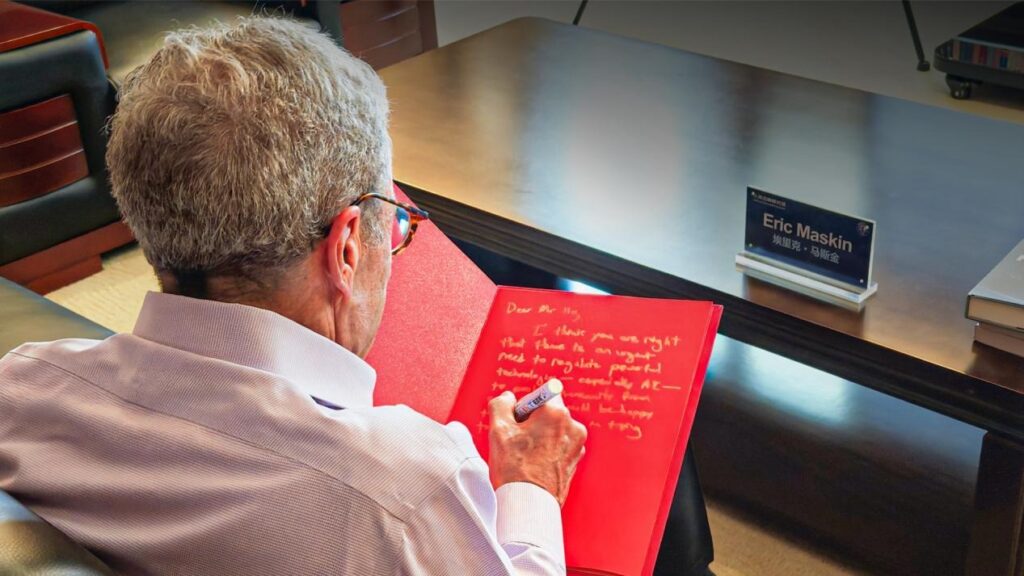
In June 2026, Mr. Hu Jiaqi, Chairman of Humanitas Ark, held an academic exchange with Professor Eric Maskin, the 2007 Nobel Laureate in Economics and a professor at Harvard University, under the theme “Technology and the Future of Humanity.”
Chairman Hu Jiaqi, an anthropologist with profound academic achievements, is the world's earliest pioneer in systematically studying technological crises and a key architect of the theoretical framework on human technological risks. Since 1979, he has conducted systematic research on human issues, published several million words of scholarly monographs, and built a comprehensive academic system. Over the years, he has focused on the potential extinction risks hidden behind rapid technological development, and has promoted global awakening to technological safety through various channels. He has written twelve open letters to world leaders, with a total circulation exceeding one million copies. He founded Humanitas Ark, which has rallied over 14 million supporters from 255 countries and regions, harnessing collective strength to advance the cause of saving humanity. Professor Maskin is one of the founding fathers of mechanism design theory, providing the foundational logic for market mechanism optimization and public policy design. For his groundbreaking work, which reshaped modern economics, he was awarded the Nobel Memorial Prize in Economic Sciences, offering vital theoretical support for the improvement of the modern economic system and sustainable global economic development.
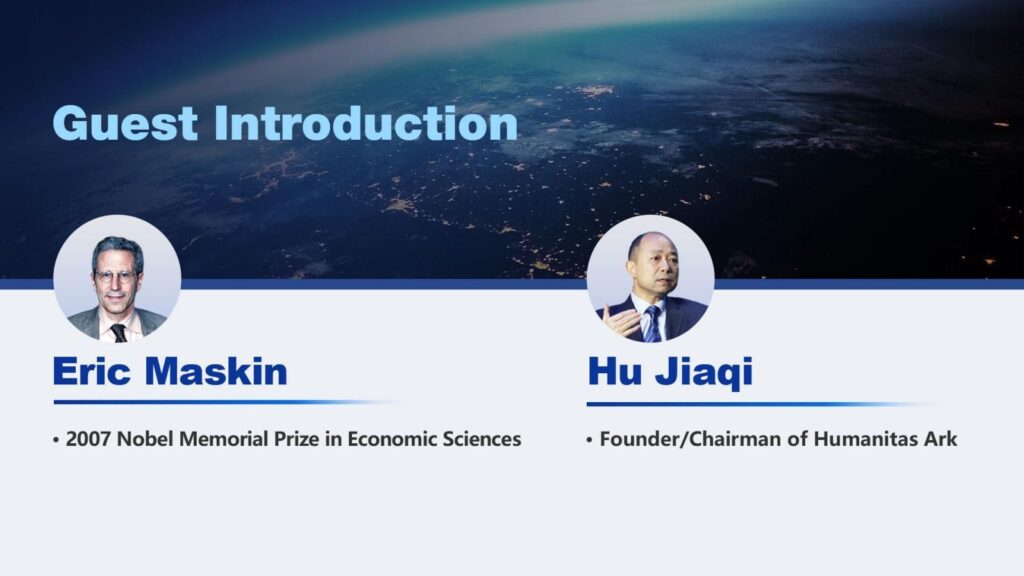
Since March of this year, Chairman Hu Jiaqi has held academic dialogues with Nobel Laureate in Chemistry Professor Michael Levitt, Nobel Laureate in Physics Professor Barry Barish, and Professor Konstantin Novoselov. This meeting with Professor Maskin marks the fourth such engagement within just a few months.
One is an anthropologist who has devoted over four decades to the study of human destiny; the other is a Nobel laureate who has reshaped the framework of modern economics. Though seemingly treading different academic paths, these two thinkers engaged in comprehensive, in-depth discussions on pivotal issues concerning humanity's perpetual survival and universal well-being, the Great Unified Society, and other key topics, jointly exploring pathways to solutions. This interview presents a complete presentation of the essence of the dialogue between these two preeminent scholars.
I. Academic Research and Dissemination Journey
Hu Jiaqi:
First of all, I would like to extend a very warm welcome to Professor Maskin for visiting my office in Beijing.
Today, I am receiving you here in my capacity as the Founder and Chairman of Humanitas Ark. The topic of our discussion today is “Technology and the Future of Humanity.”
In 1979, I entered university with excellent grades at the age of just 17. Although I scored 99 out of 100 in physics, I had never even heard of Einstein. This was because my middle school and elementary school years coincided with the Cultural Revolution, a time when education in China was neglected and much of the knowledge taught was fragmented.
After entering university, I was exposed to a great deal of cutting-edge scientific knowledge, which gave rise to a thought: the power of science and technology is immense. This power can both benefit humanity and destroy it. Could it one day lead to the extinction of the human race?
Based on my intuitive judgment, that possibility was not out of the question. But was this idea scientifically sound and reliable? And if science and technology were indeed on the verge of annihilating humanity in the near future, was there a way to save us?
I felt that in a lifetime, it is rare for a person to accomplish one truly meaningful endeavor. So I decided to dedicate my entire life to just one thing: to thoroughly study this issue and then share my conclusions with the world.
After graduating, I first worked at a research institute and later at a government agency. However, I never had sufficient time to complete my research. Eventually, I decided to resign from my government post and go into business, hoping to earn some money and then settle down to finish writing my book.
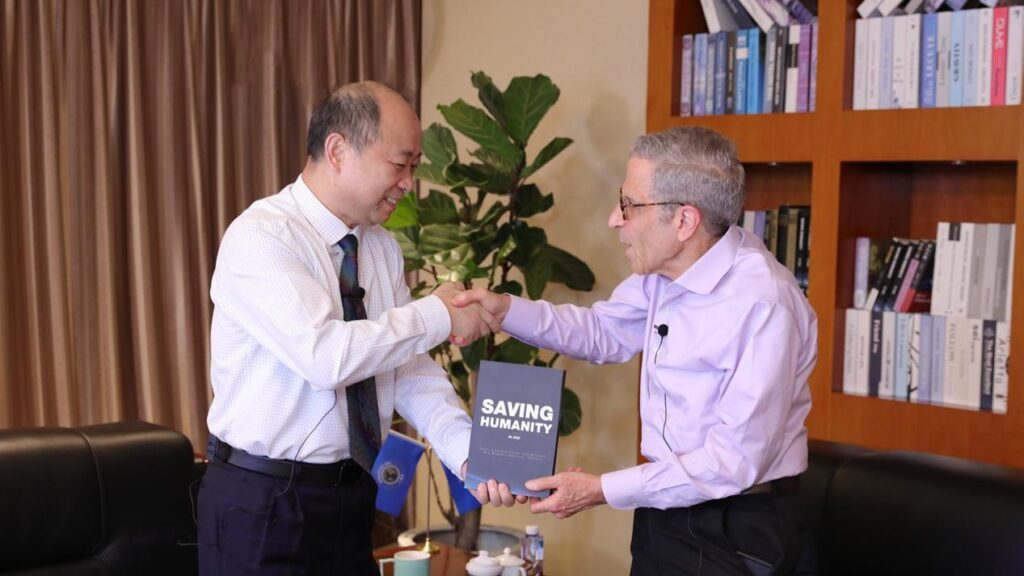
At the end of 1993, I went into business and quickly made my first fortune. I then handed over the management of my company to others and spent ten years at home writing, six of which were almost entirely spent in full‑time dedication to the work. Finally, in 2007, I completed the writing of Saving Humanity — a book that took me twenty‑eight years in total.
The publisher gave this book very high praise, commenting that it was “a book that could very likely change the course of human history.” During the distribution process, the publisher also held a fairly large press conference. However, that press conference brought me no good news. Shortly afterward, when the book came to the attention of the national publicity and regulatory authorities, its distribution was halted.
Maskin:
But has the book been published in other countries?
Hu Jiaqi:
Yes, it has. Later, I had it translated into English and Russian, and it was published in both Singapore and Hong Kong.
I believe this book is a very important one for humanity. In order to promote it, I have written twelve letters to global leaders — sending over a million copies in total.
To further advance the book’s reach, I once had a plan to become the richest man, thinking that if I could achieve that status, my voice would carry more weight. I actually implemented this plan and concentrated all my funds into it. However, the plan failed — it didn’t work out.
After that failure, I founded Humanitas Ark in 2018. Its predecessor was called the Save Human Action Organization, which was later renamed Humanitas Ark. At present, our organization has over 14 million supporters.
In March of this year, we launched a program of dialogues with world‑class scholars. My plan this year is to hold dialogues with one Nobel laureate each month, for a total of ten Nobel laureates. This is a new small initiative of ours — to seek understanding and support from top scholars around the world. You are the fourth Nobel guest we have invited. We have already held dialogues with three Nobel laureates previously.
Maskin:
I heard you talked to Michael Levitt. I just saw Michael Levitt two weeks ago.
Hu Jiaqi:
We did have a dialogue not long ago. I wonder if he has mentioned this to you?
Maskin:
We didn't have a chance to talk about that.
II. Hu Jiaqi Introduces His Academic Framework
Hu Jiaqi:
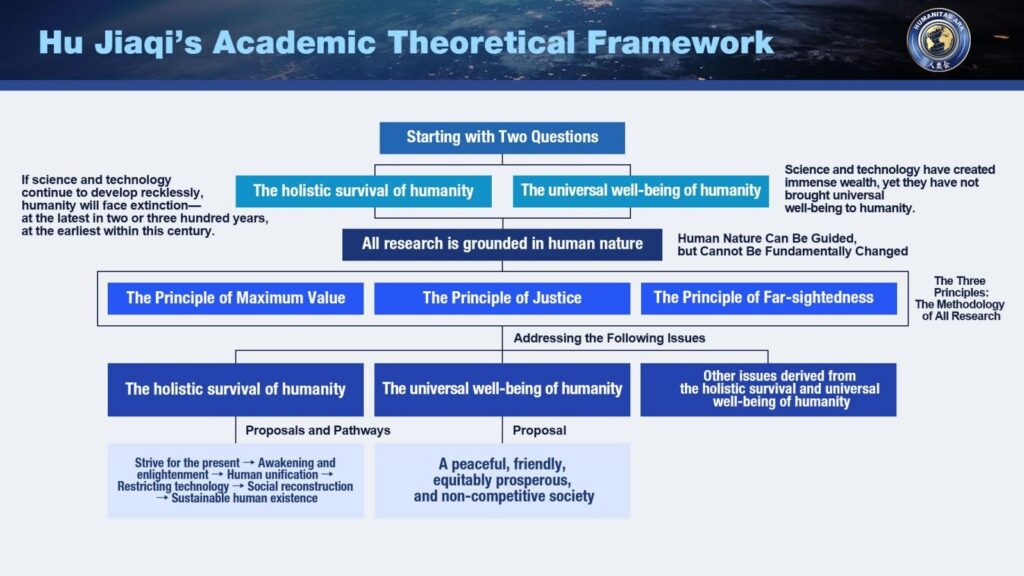
Next, I would like to provide a systematic overview of the research results I have accumulated over these many years.
Although my initial concern was whether science and technology would lead to the extinction of humanity, as my research progressed, I discovered that fully addressing this question involves far too many interconnected issues.
A simple study might require only a single paper, but I found that my research needed two books totaling 800,000 Chinese characters to adequately explain everything.
Ultimately, starting from the question of humanity’s overall survival, my research had to be approached from two dimensions: one is the overall survival of humanity, and the other is the universal well‑being of humanity.
With regard to the overall survival of humanity, the final conclusion of my research is this: if science and technology continue to develop at this frenzied pace, they will exterminate humanity within at most two to three hundred years, or as soon as within this very century. This is not a mere possibility — it is an inevitability.
With regard to universal well‑being, both my research and that of many other scientists have reached the same conclusion: science and technology have created boundless wealth, but they have not brought universal happiness to humanity.
Since time is very limited today, we can only discuss one of these issues — the overall survival of humanity.
All of my research is grounded in human nature. I believe that human nature can be guided, but it cannot be fundamentally changed.
Maskin:
I want to say that I agree with that point very much.
Hu Jiaqi:
I believe that any social system design that goes against human nature is bound to fail. Therefore, in my 800,000‑word book, a significant portion is devoted to the study of human nature.
Based on human nature, I have formulated three fundamental principles for myself: the Principle of Maximum Value, the Principle of Justice, and the Principle of Far‑sightedness.
Maskin:
What is the principle of maximum value?
Hu Jiaqi:
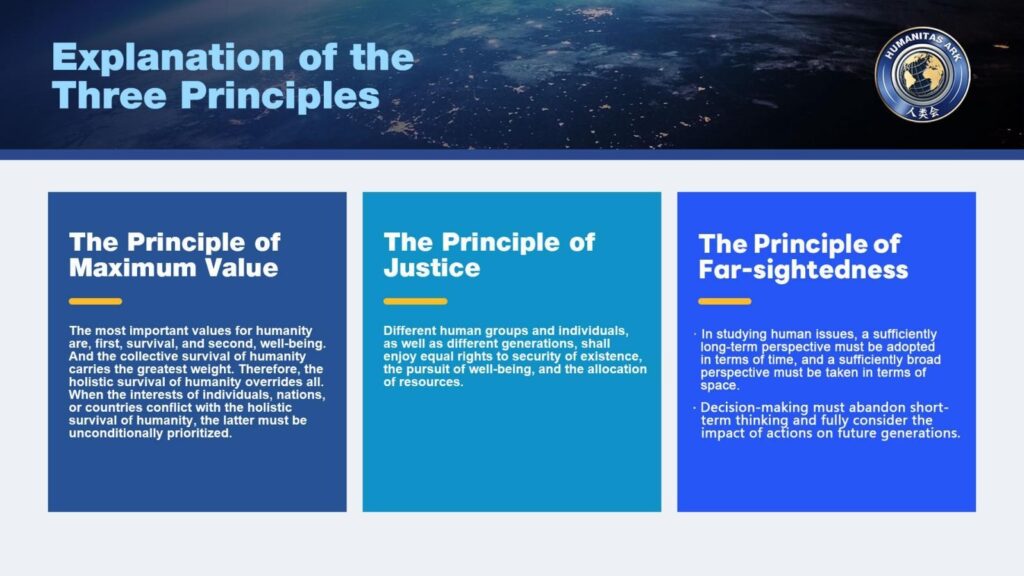
I believe that there are only two most important values for humanity: one is survival, and the other is happiness.
For the human species, there are no values more important than survival and happiness. Furthermore, the collective interest of humanity as a whole carries the greatest weight. Therefore, the holistic survival of humanity overrides all. When a fundamental conflict arises with the interests of humanity as a whole, any group must submit to the greater interest of all humankind.
Moreover, since the overall survival of humanity is even more important than happiness — serving as the very carrier of happiness — the overall survival of humanity takes precedence over everything. This principle later became my motto, and also the motto of Humanitas Ark: “The holistic survival of humanity overrides all.” On the flyleaf of my book, these very words are inscribed. This is the Principle of Maximum Value.
As for the other two principles, I can only briefly touch upon them due to time constraints.
The Principle of Justice means that any distribution of resources and any establishment of conditions should be evaluated and determined in accordance with the principle of justice.
Maskin:
And what is the Principle of Justice?
Hu Jiaqi:
For example, humanity may survive on this planet for many, many years to come. The people of today must not exhaust all the resources and consume everything that belongs to future generations — this is an issue of intergenerational justice. That is just one example.
The Principle of Far‑sightedness means that we must evaluate all our institutional designs on an extraordinarily broad scale. Because it is entirely possible for humanity to survive on this planet for hundreds of millions of years without issue. Dinosaurs survived on Earth for 160 million years, and the nautilus has survived for 530 million years. Humanity’s capacity to cope with nature is even stronger than that of dinosaurs and nautiluses. If left to the forces of nature alone, it would be extremely difficult to wipe out humanity.
Many of our considerations, measured on the scale of a hundred or a thousand years, I believe, are still too short. That is why my research, in terms of the span of time, extends from the beginning of the universe to its very end. And in terms of the span of space, it extends from beneath our feet to the very edge of the universe. This does not mean that we are going to do anything in the distant future, nor does it mean that we are going to do anything at the far reaches of the cosmos. This is simply a research methodology, a frame of reference. The problems we need to solve are still the problems of the present moment.
Thus, these three principles constitute the methodology for all of my research. If one believes that my research methodology is flawed, then all of my subsequent findings may well be erroneous.
Through this methodology, I aim to address three major issues: first, the overall survival of humanity; second, the universal well‑being of humanity; and third, all other issues derived from the overall survival and universal well‑being of humanity.
In a word: I simply want to solve all of the greatest problems facing humanity.
So today, we will focus our discussion on the overall survival of humanity. I believe that in order to solve the problem of humanity’s overall survival — namely, that science and technology will soon bring about the extinction of our species — we must achieve the Great Unification of humanity, placing science and technology under the control of a world government.
However, achieving this Great Unification is no small task. The difficulties are enormous, and it will likely take a very long time. That is why we must chart a path forward.
Maskin:
By a unified society, you mean a society for the whole world? A global society?
Hu Jiaqi:
Yes, this is something unprecedented in human history.
Maskin:
That's right and it sounds to me as something very difficult to achieve. Because we have different countries and these countries are not going to want to give up their autonomy.
Hu Jiaqi:
Yes, I will address that question after I finish explaining the points below.
Our path is to strive for action in the present. By that I mean, even now, when science and technology pose certain dangers, we must make every effort to contain them.
Maskin:
When when you say avoid technologies harmful technologies, you mean banning them all together or possibly simply regulating them.
Hu Jiaqi:
I believe we should do as much as we can. Take nuclear weapons, for example — they are a means of destruction. Although there is not much we can do about them, we can still reach agreements among nations to prevent nuclear proliferation.
Maskin:
I mean, there have been agreements on nuclear weapons, for example, between the United States and the former Soviet Union.
Hu Jiaqi:
Yes. Although the so‑called legitimate five nuclear powers — the five permanent members of the Security Council — were allowed to legally possess nuclear weapons, in reality, today India, North Korea, Israel, and Pakistan have all developed their own nuclear weapons.
Maskin:
They do.
Hu Jiaqi:
This reveals two things. First, the Nuclear Non‑Proliferation Treaty is not entirely effective. But without it, there might already be dozens of countries around the world with nuclear weapons today — including Iran, which is currently at war. That is why we say we should strive for action in the present and do as much as we can.
Second, we need to promote an awakening and enlightenment movement — to help people gain a new understanding of science and technology, so as to achieve the Great Unification of humanity. Through this Great Unification, we can impose restrictions on science and technology — especially high‑risk technologies — including permanently sealing off certain areas of theoretical research.
Maskin:
I would like to learn more about the specifics of the awakening and enlightenment movement you just mentioned.
Hu Jiaqi:
We need to use every possible means to help people re‑examine science and technology — to understand its extreme dangers, and to recognize that without achieving the Great Unification and placing science and technology under the control of a world government, humanity will rapidly march toward extinction. I will come back to this point in greater depth after I finish the rest of my explanation. We also need to restructure society in order to achieve the perpetual survival of humanity.
And to achieve universal well‑being and ensure the stability of a unified global society, I have envisioned a future society — one that should be peaceful, friendly, equitably prosperous, and non‑competitive.
III. Discussion on the Phenomenon of Social Competition
Maskin:
So there I think you run into the problem that a market based society which has been the source of great prosperity is fundamentally competitive.
Hu Jiaqi:
So our future social goals will be different from those of today.
Maskin:
But I'm not sure that's consistent with human nature. Humans are naturally competitive.
Hu Jiaqi:
Absolute competition can never be eliminated. What I mean by a non‑competitive society is one with diminished competition, not the intense competition we see today.
In my study of human nature, there is one point I hadn't planned to bring up today, but since you raised the issue, Professor, let me address it briefly. In my analysis of human nature, I have identified a trait I call “the eternal tendency toward conflict.” That is to say, this competitive instinct in humans is eternal — it can never be eradicated, only mitigated.
Maskin:
But competitiveness is not an entirely bad thing, because competition makes us work harder and produce more for society.
Hu Jiaqi:
In a future society, I believe we should not aim too high. Today’s national societies, I think, should remain competitive, because the relationship between nations is inherently one of intense, life‑and‑death competition. However, once humanity achieves the Great Unification, the greatest driver of competition — the nation‑state — will disappear, which makes it possible to diminish competition.
As I said, all my research is grounded in human nature. I believe that human nature can be guided, but it cannot be fundamentally changed. What we are doing is guiding people to gradually soften this aspect — not to eliminate competition entirely, because a society with absolutely no competition does not exist.
The same goes for peace, friendliness, and shared prosperity — a society of absolute equality does not exist either. What I mean by “shared prosperity” is relative. For example, in a unified global society, there should be no giant mega‑corporations, but rather more small and medium‑sized enterprises. Even so, the owners of these enterprises would still earn somewhat more than ordinary employees. Similarly, peace and friendliness are not absolute — they are relative.
But if we continue down this line of discussion, we could talk for days. So I think we should first focus on the main issue. After we finish discussing the first question, if time permits, we can move on to other topics.
IV. Discussion on the Argumentation Methods for Tech‑Induced Extinction
Hu Jiaqi:
Now, the second thing I want to talk about — and this is where I most need your support, Professor — is how I demonstrate that science and technology will inevitably drive humanity to extinction in a very short time.
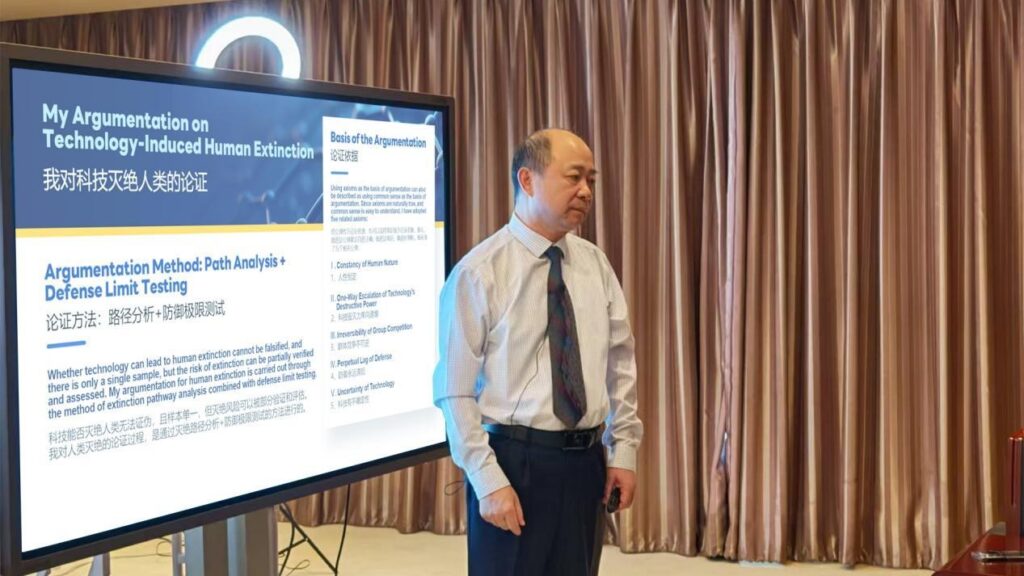
My methodology is extinction pathway analysis + defense limit testing. My reasoning is based on axioms and common sense. Because the question of human extinction cannot be falsified, and we have only a single sample. The only intelligent life like us that we know of is our own species — Homo sapiens. The only planet known to harbor such intelligent life is Earth. So we have just one sample. And since extinction has never occurred, there is no precedent to follow.
The experiment cannot be replicated either. However, it can be partially verified and assessed. That is why I designed my research methodology as extinction pathway analysis + defense limit testing. All of my arguments are grounded in human nature, as well as in common sense and axioms. Axioms are self‑evidently true; common sense is readily understandable.
Which axioms? I rely on five axioms: first, human nature is constant; second, the destructive power of science and technology increases unidirectionally; third, group competition is irreversible; fourth, defense always lags behind; and fifth, science and technology are inherently uncertain.
Maskin:
What does irreversibility of group competition mean?
Hu Jiaqi:
Take the current wars between nations for example. The United States and the Soviet Union competed and produced so many nuclear weapons. After the Soviet Union collapsed, it seems that the United States now stands alone as the sole superpower. But competition between nations has always existed — including today’s conflicts between Iran and the United States, and the competition between Russia and Ukraine. This kind of competition is impossible to change.
Maskin:
So I agree with some of that. But i think it's important to remember that since 1945, when nuclear weapons were invented, they have never been used in war, since 1945. Despite competition, there has been some limited control over nuclear weapons, which has prevented their use in war.
Hu Jiaqi:
Actually, as soon as nuclear weapons were developed, they were used — in Hiroshima and Nagasaki, Japan.
Maskin:
Once. That's the only time they've ever been used. One time.
Hu Jiaqi:
Yes, only once. For eighty years, there has not been a second use. But you can look at my research methodology — the Far‑sightedness Principle. We humans cannot only consider eighty years, nor eight hundred. Under natural conditions, humanity is capable of surviving for hundreds of millions of years. Moreover, Putin has repeatedly threatened to use nuclear weapons.
Maskin:
He's threatened this. I'm not sure whether we should believe him.
Hu Jiaqi:
There is more than one madman like Hitler in this world. In the long run, there will be plenty of people even crazier than Hitler.
I can make a hypothetical assumption: if it had been Germany, not the United States, that first possessed nuclear weapons, I believe that when the Allied forces marched into German territory, Hitler would have definitely used them.
Maskin:
I agree. But the fact that we've had eighty years of success is a promising sign.
Hu Jiaqi:
But we humans cannot rely on a probabilistic hope when it comes to our overall survival. Because the overall survival of humanity is something we only have one chance at.
Maskin:
You're right.
Hu Jiaqi:
My first step of argumentation is that technological development inevitably leads to the ever‑increasing destructive power of tools. This is common sense. In the age of cold weapons, a sword or a blade could only kill one person. After the invention of gunpowder, explosive shells could wound an entire area. Today, with the mass‑energy equation, a single nuclear bomb can destroy an entire city. So it is common sense that technology continuously enhances the destructive capacity of tools — that is my first step.
My second step is that the acceleration of scientific and technological development began with the Industrial Revolution. Since then, technology has been rapidly approaching the capability to extinguish humanity. Modern science and technology are growing at an exponential rate. People's concerns about the safety of many technologies today are no longer about how many people they could kill, but whether they could wipe out humanity altogether — including genetic engineering, nanotechnology, artificial intelligence, and so on.
My third step is that as long as science and technology continue to develop uncontrollably, the destructive power of means will keep increasing until a means of extinction eventually emerges. That is to say, even if the genetic engineering we worry about today cannot wipe us out, even if nanotechnology cannot, even if artificial intelligence cannot — as long as science and technology keep advancing, something even more powerful will inevitably emerge. And that something, sooner or later, will ultimately possess the capability to exterminate humanity.
Maskin:
But the technology is not developing completely uncontrollably. For example, there are strong restraints on gene technology at the moment. Gene technology cannot be used to change the genetic inheritance of human beings.
Hu Jiaqi:
I agree with you, Professor — not all technologies are moving in the direction of wiping out humanity. But as long as even one technology heads that way, humanity will be wiped out.
Maskin:
That's true.
Hu Jiaqi:
Fourth — and this is also an axiom, a matter of common sense that needs no proof — means of extinction cannot be neutralized. In other words, they are simply indefensible.
Some means of extinction cannot be countered. For example, a nuclear explosion releases energy that causes destruction, and that destruction is irreversible. But some means can be defended against — for instance, biological toxins created through genetic engineering, or plagues caused by viruses and bacteria, can be treated by developing drugs. However, defense always lags behind destruction. Even developing a drug takes time.
And after the first means of extinction emerges, there will be a second, a third, a fourth. Moreover, as science and technology continue to advance, the means of extinction will shift from being accessible only to a nation, to being available to a corporation, and even to an individual. This window of risk is going to keep getting longer. Eventually, it will erupt. So means of extinction cannot be defended against. This is my “defense limit testing” methodology, and it is also an axiom.
Fifth, the eruption of extinction forces is inevitable. It can happen in three ways: first, some people actually want to wipe out all of humanity — extremists may use it deliberately. Second, laboratory accidents could also trigger an extinction force, because science and technology are inherently uncertain — we are exploring the unknown. Third, improper use of technological products could also lead to the release of extinction‑level means. Many technologies are used without a full understanding of their properties — just like Freon caused damage to the ozone layer.
Now here's the problem: a conclusion derived from axioms and common sense is not a popular one. First, nations don’t like it — because they rely on science and technology to grow their economies, build their militaries, and strengthen national power. Second, corporations don't like it — because they need science and technology to increase profits and expand production. Third, ordinary people don’t like it either — because once they get used to smartphones, they can't let them go. They want better, more convenient tools.
You may not like the truth — yet you cannot avoid facing it.
V. Discussion on the Probabilistic School of Thought
Hu Jiaqi:
Currently, there is a group of scientists engaged in research on the safety of science and technology. The mainstream approach is probabilistic. Most of them use Bayes' theorem for their probability studies. But I believe that the probabilistic approach is unscientific and even harmful.
To use this method, you first have to build a mathematical model, and then assign values to various parameters. These parameter values are based on expert opinions — including the experts’ own assessments. Yet the opinions of experts often differ wildly.
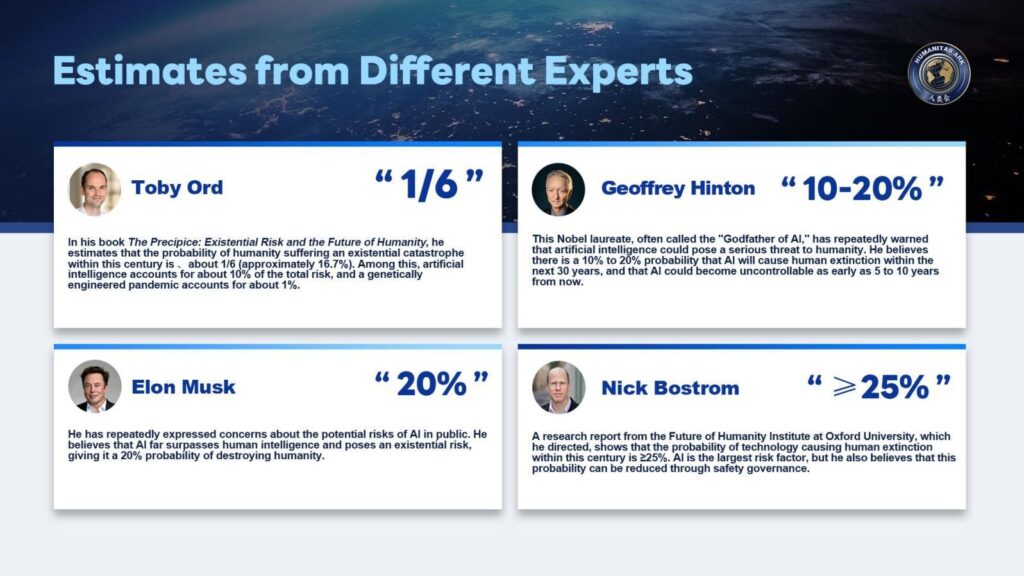
For example, Toby Ord — a philosopher at the University of Oxford — estimates that the probability of science and technology causing human extinction in this century is one in six.
And Geoffrey Hinton believes that out‑of‑control AI could lead to human extinction. He puts the chance of that happening within 30 years at 10% to 20%.
Maskin:
By the way, I had a conversation with Geoffrey Hinton last month about the regulation of AI. He would be quite sympathetic to your point of view.
Hu Jiaqi:
He (referring to Hinton) also said that AI could become uncontrollable within as little as five to ten years — this was in an interview with a reporter.
Elon Musk believes the probability that AI could wipe out humanity is around 20%.
Nick Bostrom puts the probability of science and technology causing human extinction in this century at over 25%.
An online prediction platform, Metaculus, surveyed about 2,000 forecasters from around the world. The results showed that the probability of human extinction by the end of this century due to technology is 9%, of which 8% comes specifically from AI.
The non‑profit research organization AI Impacts conducted a survey of 2,700 AI researchers. The median probability from that survey was that AI would cause human extinction within a century with a probability of 5% to 10%.
Max Tegmark believes that the probability of technology causing human extinction in this century is 90%.
And some AI safety researchers argue that the probability of AI going out of control and wiping out humanity is 100%.
Why do I think that using a probabilistic approach to study technology‑induced human extinction is unscientific? First, their bases of estimation are completely different — the parameters themselves are all different. Take the Bayesian formula — whether it's the prior probability or other values, none are fixed.
But there’s another reason why I think it's meaningless: because the overall survival of humanity is an infinite value — we have only one chance, and we cannot afford a single failure. Whether it’s 1% or 99%, neither is 100% — but is there anything worth taking such a huge risk for? So 1% multiplied by infinity is approximately infinity, and 99% multiplied by infinity is also approximately infinity.
However, having this probability creates trouble. I think probability is very harmful. Why? Because it gives people false hope.
Humans have a tendency for self‑deception, and also a bias toward immediate interests — this is determined by the weaknesses of human nature. What I mean by 'immediate‑interest bias' is that when weighing present benefits against long‑term ones, people choose the present; when superficial interests conflict with fundamental ones, they tend to choose the superficial.
There is a Chinese folk saying: “If you gamble long enough, you will eventually lose.” I wonder if there is a similar saying in Western countries.
Maskin:
But it all depends how much you're risking. If you’re risking all you have, then yes, you will eventually lose. But if you're only risking a small amount and then maybe you will succeed in the end.
Hu Jiaqi:
Today, we are gambling with the very survival of all humanity — and that is a bet that is far too large. But the probabilistic approach gives people false hope. There are plenty of gamblers in this world who stake everything they have and lose it all.
Maskin:
Right, that's a mistake.
Hu Jiaqi:
Yet today, even so many scientists, when faced with AI and advanced technologies, have said that technology could wipe out humanity in this century. They’ve given us these probabilities. So what could be more important than the survival of all humanity that we would take such a risk?
But the weaknesses of human nature lead people to turn a blind eye to even such a monumental issue — because it offers so many benefits and immediate gains.
Maskin:
I'm not sure I understand. Geoffrey Hinton, for example, thinks there's a twenty percent chance of extinction within thirty years. That doesn't sound very hopeful.
Hu Jiaqi:
It’s 10% to 20% — but it's still rising.

VI. How to Awaken Humanity to the Risks of Technology
Maskin:
But, I think that may change in the next few years depend on political leadership. The United States at the moment has very bad political leadership. But that is , that is probably going to change quite soon.
Hu Jiaqi:
On this point — like I said — we need an awakening movement, to get people to see science and technology in a new light. And honestly, even if we slammed on the brakes today, it might be too late. Because getting people to really understand this problem is hard — and even if they do, stopping it is even harder. So Humanitas Ark will keep doing what we've been doing — raising awareness. I’ve been at it for nearly half a century now.
Maskin:
So I agree that there is not enough public awareness of these risks. What can we do about that?
Hu Jiaqi:
I believe we need to do two things: first, strive for action in the present; second, promote an awakening movement — to make people deeply aware of this issue.
Maskin:
How do we do that?
Hu Jiaqi:
I'd like to talk about several famous enlightenment movements in human history. The first is the European Renaissance. It was not until two or three hundred years after the Renaissance that the Reformation took place, and about one to two hundred years after the Enlightenment that the United States emerged as the world’s first democratic country. So enlightenment is essential — without it, social transformation would not have been possible.
Maskin:
Right. But that was five hundred years ago.
Hu Jiaqi:
History always moves forward. Any point in history, looking back from the future, is the past. The problem we face today is even greater than those before. So we need a group of people to push for a new understanding.
Maskin:
I agree with you. But the question is, how do we get people's attention.
Hu Jiaqi:
Yes, we have been doing this all along. I have been at it for nearly half a century, and the results have not been good. We even sent emails to you, Professor. I have also said that perhaps we may not succeed in this endeavor. But among all those working on this, we want to be the hardest‑working drop of water.
Fortunately, in recent years, with the development of AI, more people have come to recognize this issue. But when I first raised it nearly half a century ago, people mocked me. When I published my book twenty years ago, it was banned.
We also know that whether during the Renaissance or the Enlightenment, it was extremely difficult to push things forward — Bruno was burned at the stake in the Campo de' Fiori in Rome, and Galileo was forced to concede that the Earth stood still.
When my book was published, although the publisher was very supportive and a small number of people appreciated it, whenever I presented its content, I was met with ridicule. But today, as I discuss this with you, Professor, I believe you at least do not find it laughable.
Maskin:
No it's not. I take it seriously
Hu Jiaqi:
But forty years ago, it was all ridicule.
Maskin:
But the question now is how to be more effective and getting the attention of the world to these problems that you pointed out . I agree with you that these are serious problems.
Hu Jiaqi:
For example, Professor, you are such an influential scholar. Our invitation to you this time is also in the hope that you can use your tremendous influence to help promote this cause. We have been doing this all along, and I believe that gradually, with our efforts, more and more people will join us.
Maskin:
And what does it mean to to join you?
Hu Jiaqi:
To spread this vision is to do the greatest good. In this endeavor, I believe the most effective voices are those of global leaders. That is why the foreword to my book is an open letter to twenty‑six global leaders — including the UN Secretary‑General and leaders of major countries.
Since then, I have sent even more letters. To date, I have sent over a million letters — about eight to nine hundred thousand via email and over two hundred thousand in print. I have also sent out about ten thousand copies of my book.
Maskin:
Have any of those leaders or scholars ever replied?
Hu Jiaqi:
Yes, there have been some. Jacques Dubochet even wrote me a rather long email — he is a Nobel Laureate in Chemistry.
Maskin:
Okay. Is he the only one?
Hu Jiaqi:
No, there are others. Many university presidents have also replied to me. And the Master of Trinity College — also a Nobel Laureate in Chemistry — his secretary replied to me.
VII. Discussion on the Society of Great Unification
Hu Jiaqi:
What people are most skeptical about right now is whether humanity can achieve the Great Unification. You also raised this question earlier, Professor — and I said I would come back to it later.
Maskin:
Right. I’m doubtful that a unified society is possible. But I have more hope that we can do something to control dangerous technology.
Hu Jiaqi:
Regarding this question of unification, I would like to address it more thoroughly today.
First, I believe that the expansion of human political entities is a major trend. Take China's Xia Dynasty — it was just a small area in what is now southern Shanxi and northwestern Henan. The Shang Dynasty was larger, the Zhou larger still, and when Qin Shi Huang unified China, it became even bigger.
The same trend holds true for the world. If we look at Western civilization today, I believe its roots lie in classical Greek civilization. In that era, the largest states were city‑states like Athens and Sparta, each with only three to four hundred thousand people. Today we have countries as large as the United States and Russia, and there was once the British Empire, which seemed to encompass the entire world.
Many people question me, saying that all of this was achieved through war and expansion. But there have also been peaceful unification — for example, the unification of East and West Germany, or the merger of the thirteen American states at the time of independence, which was voluntary, not through war. That was peaceful unification.
Maskin:
Right. But most unifications have been by force. Or certainly not by mutual agreement. The British empire, for example, was not achieved peacefully.
Hu Jiaqi:
Yes, but there are also cases achieved through peaceful means — like the merger of the thirteen American states and the unification of East and West Germany, both accomplished peacefully.
Some people challenge me by saying that only an alien invasion could unite humanity, because if we didn’t unite against it, we would face annihilation.
But today we face the same problem: if we do not achieve unification and strictly control the development of science and technology, it will also lead to human extinction.
The alien invasion scenario is too intuitive and simple, whereas the idea that humanity will be wiped out if we fail to achieve the Great Unification and take control of science and technology — that requires deep thinking. And that is precisely why we need an awakening movement.
Maskin:
But I'm not sure that we need to unify all countries into a single country to be able to control technology. Take the example of climate change. We can potentially control the future of climate change through an international treaty. We don't need to unify the whole world in order to have a global treaty.
Hu Jiaqi:
Because climate change involves relatively smaller issues — but the problem we are facing now is enormous. It leaves no room for error. That is why we must adopt a stronger governance structure for human society.
Maskin:
Right, I agree that there are that there are many risks besides climate change. But I'm not optimistic that's we can create a single global society. I think we should be working to solve this problem, given the existing world configuration.
Hu Jiaqi:
On this point, I may need to elaborate a bit more.
First, from my study of human history, I have come to believe that there is only one hard constraint that prevents the expansion of a political entity — and that is the inconvenience of transportation and communication, which makes it impossible to govern a large territory.
Wherever transportation and communication can reach, war will extend there, and unification will also be possible there as well.
Maskin:
Are you saying that we have to stop transportation and stop communication?
Hu Jiaqi:
Today, the convenience of transportation and communication has shrunk the world to a global village. So this hard constraint is no longer a problem. What we lack now is simply a consensus — a consensus on achieving the Great Unification.
Maskin:
But I thought before you said that war was caused by communication and transportation
Hu Jiaqi:
What I mean is that unification has often been achieved through war. But today, we are talking about peaceful unification — and that requires consensus. Within that framework, a convenient means of governance can be applied.
Maskin:
I think we have already done some of that. For example, the European Union is a partial unification of Europe,which was achieved entirely peacefully.
Hu Jiaqi:
In fact, even before the European Union, there were two notable examples worth mentioning. First, after World War I, people saw that a single war had spread across the entire globe. So the scholar‑like U.S. President Woodrow Wilson proposed the establishment of the League of Nations. Although the League of Nations was not a state itself, it required member states to cede part of their sovereignty, and it had a global character.
Maskin:
The League of Nations was a complete failure.
Hu Jiaqi:
Yes, the League of Nations failed to prevent the outbreak of World War II.
Maskin:
The United States wouldn't even join the League of Nations.
Hu Jiaqi:
The United States did not join because the U.S. Congress did not approve it.
Maskin:
That's right.
Hu Jiaqi:
World War II was even more devastating than the First. After it ended, the leaders of the four major powers still thought it necessary to establish an international organization — and that gave birth to the United Nations. The United Nations was established with lessons drawn from the League of Nations, which is why it adopted the principle of great‑power consensus.
Maskin:
The United Nations only had limited success. It has not been a very strong organization. A much more successful international organization has been the International Monetary Fund. International Monetary Fund, they have been successful.
Hu Jiaqi:
Take the United Nations again as an example. The UN has at least ensured that there have been no major wars in the world for these eighty years. The UN requires member states to cede more sovereignty than previous international organizations — but even that is still not enough.
Maskin:
But not because of the United Nations. I think the fact that the United States was the major military power in the world had the most to do with the absence of war, with the absence of war. The United States has been the the policeman for the world.
Hu Jiaqi:
I may have a different view on this. The United States certainly played a significant role, but I believe nuclear deterrence also played a very important role in that.
Maskin:
Yes, but the United States had a lot to do with the non-use of nuclear weapons. The United States made agreements with the Soviet Union, for example, not to use nuclear weapons. The United Nations did not play an important role in stopping nuclear weapons from being used.
Hu Jiaqi:
In fact, the UN has become increasingly weaker over time, and its role in world affairs has been diminishing. But without the UN, many things would be even more troublesome. When major issues arise, people still naturally think of using the UN to resolve them — that’s a very normal thing.
If today we were not facing the problem of human extinction, we might still be thinking about establishing a better world organization, or reforming the UN. But the problem we face today is too enormous. An international organization that merely requires member states to cede some sovereignty is no longer sufficient. We need to merge nations and establish an overall world government.
Let me talk about Chinese history. For several hundred years before Qin Shi Huang unified China, the country was divided into various states. Powerful states kept emerging and disappearing, and they maintained a balance through various means. No one believed that a unified regime could ever be achieved on this land — because there had never been a truly unified regime there before.
In the final period, known as the Warring States period, there were seven powerful states, with Qin being the strongest — yet even Qin struggled to push unification forward. The other six states used every possible means to block Qin's unification — one day through one form of cooperation, another day through another — which made everyone believe that a unified regime on this land was impossible. But in the end, unification did happen — though it was achieved through war. Today, we hope to achieve it through peaceful means.
Maskin:
And I like the idea of unification. But i think the way to achieve unification is through international agreements Not through merging all countries into one. For example, I think there's no chance that the United States and China will become, will merge and become one country. That that's an impossibility. Instead, China and the United States will agree on many projects such as stopping climate change and stopping the unregulated growth of AI.
Hu Jiaqi:
On this point, I would like to quote what I said in my previous dialogues with three other Nobel laureates: Confucius, the great Chinese thinker, once said, “Gentlemen are harmonious though they may differ.” As long as we share a common love for humanity, even if we hold different views, we can still be good friends.
Maskin:
I agree, and in fact, that's what I was saying. The US and China have many disagreements. But they can agree on the importance of climate change. And they can agree on the importance of regulating technology.
Hu Jiaqi:
To thoroughly discuss this issue today, I think it would be very difficult — because time is quite limited.
VIII. Several Important Convergences of Thought
Hu Jiaqi:
Thank you very much, Professor, for listening to me present my ideas at such length. Let me just add one final point: some of my views have actually been echoed by others over time.
In 2007, I published a book — it is a comprehensive work covering many topics. One of the points I made in it was a strong opposition to any contact between humanity and extraterrestrial life. Two years later, Stephen Hawking issued the same warning — he said we should not provoke the aliens.
Six years later, in 2013, the Future of Humanity Institute at Oxford University, under the leadership of its director Nick Bostrom, completed a report. It stated that humanity could face extinction as early as the next century, and that the primary culprit would be science and technology.
This was the first time a formal report had come close to the views expressed in my book. So I published an article in Hong Kong's Frontier Magazine, titled “Finally I’ve Got a Bosom Friend.”
Then in 2014 — seven years after my book was published — Hawking raised the concern that out‑of‑control artificial intelligence could lead to human extinction. I had already addressed that in my 2007 book.
In 2017 — ten years after the publication of my book — Hawking said that to solve this problem, we might need to establish some form of world government to exercise oversight. That world government aligns perfectly with my concept of the Great Unification of humanity.
Maskin:
Yes. But I don't think a world government is as possible anytime soon. I think we need to act now to regulate technology and environmental damage. We can't wait until we have a world government.
Hu Jiaqi:
What you've said, Professor, I believe is precisely what we need to do right now — and what we should be doing. This is what I mean by “striving for action in the present.” But as for the Great Unification of humanity, I still believe it is the most fundamental solution.
Maskin:
Maybe that's true, but that will be many, many years from now. The urgent task now is to place effective controls on technology. I agree with you that they that there are very big risks with technology.
Hu Jiaqi:
Time is not on our side. Technology is advancing too fast. I’m afraid we may not have enough time to get there.
Maskin:
I agree with that.
Hu Jiaqi:
A drowning man will clutch at even a straw. Even if we truly cannot save ourselves, we still have to give it everything we've got.
Contact Person: Reese Jin
Company Name: Humanity Issues Research Institute
City: Los Angeles
Country: U.S.A
Website: en.savinghuman.org
Email: shao@savinghuman.org