
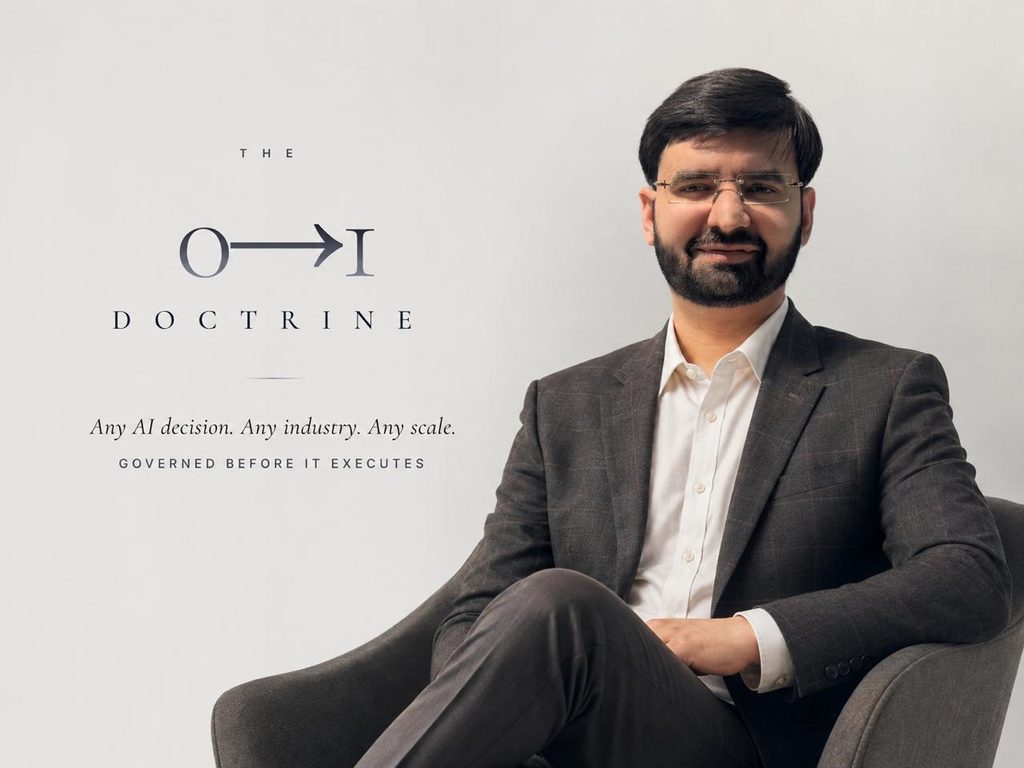
AI agents already propose trades, draw margin, and release funds on their own, outrunning the review cycles built to watch them. Risk researchers ask whether faster agents make that risk larger, not smaller — as the Singularity, quantum computing, and AGI edge closer, and agent swarms multiply globally. Where a meaningful boundary exists, the 0→1 Doctrine normalises the eligible action between 0 and 1 before it executes; HOP–Human Oversight Pathway is the route to a verified human the instant the math cannot resolve on its own.
Live: www.0to1doctrine.com
A PROMISE WITH NO TIMESTAMP
Every firm running agentic trading says a human remains in the loop. The promise rarely says when.
Not before the trade — that defeats the purpose of building the agent. Not during — a proposal executed in milliseconds leaves no window to intervene. Oversight, in practice, happens after: a log, a report, a question asked once something has already gone wrong.
A PATHWAY, NOT A PAUSE BUTTON
The 0→1 Doctrine tests a proposed action against its authorised boundary. 0 means no alignment with that boundary. 1 means full alignment. Where a boundary applies, the test happens the moment the action is proposed — before it executes, not after.
The agent still chooses the strategy. It does not choose whether a boundary case reaches a person. When a case can't resolve on its own, the pathway sends it to one — a named person, not a log for later.
THE RACE WITH NO REFEREE
The Singularity, quantum computing, and AGI remain years off enough to debate. Industry observers note that most agentic AI in finance today concentrates on research, surveillance, and operational tasks — but retail platforms already let agents place trades directly, and that line is moving.
The harder question is who is authorised to govern their actions.
FIVE SCALES, FIVE DOMAINS, ONE GATE
- A retail trading agent's position band [0.81–0.87] is checked against the account's authorised band [0.50–0.78]. No intersection → BLOCKED before the order routes. Receipt issued — not caught in a statement read weeks later.
- A hospital's procurement band [0.55–0.61] is checked against its authorised band [0.50–0.79]. Intersection → APPROVED at agent speed. Receipt issued, no committee delay, no change to the hospital's own purchasing rules.
- An insurer's claims band [0.79–0.85] is checked against its authorised band [0.50–0.78]. An edge case, no clean intersection → HOP triggered. Receipt issued. the Predictive Risk Advisory Token (PRAT) flags the risk to a named claims officer before the payout settles — the model's own confidence is not the deciding vote.
- A power-grid agent's load-shed band [0.83–0.89] is checked against the safety band [0.50–0.78]. No intersection → BLOCKED before dispatch. Receipt issued, not reconstructed from telemetry after an outage.
- A swarm of procurement agents proposes orders whose combined band [0.81–0.87] is checked against the quarterly authorised band [0.50–0.78]. No intersection at the aggregate, though no single order breached it alone → HOP triggered. Receipt issued. the Emergent Meta-Environmental Response & Governance Envelope (EMERGE) flags the systemic pattern before any one desk notices it, let alone acts on it.
Five scales, five domains, one band-intersection law, checked the same way every time — approve, block, or hold for a named person, each outcome closed by a receipt.
ONE ARCHITECTURE, EVERY JURISDICTION
A firm in one country sets limits under one regulator; a firm elsewhere answers to entirely different rules.
The pathway doesn't harmonise any of that. Every firm's own limit runs through the same architecture — local mandate, everywhere it operates.
WHERE IT DOESN'T HELP
This is not a claim that agentic risk disappears. A model can still propose a bad trade — the gate only checks whether it sits within a limit already set.
It does not replace a risk officer, a regulator, or a firm's own controls. It governs one moment none of those three ever reached: the millisecond between proposal and execution. Forced onto a decision with no real boundary to test, it adds friction, not safety — and should not be used there.
THE CHAIN BEHIND THE ROUTE
Every action starts as a User System Parameters record (USP) — the user's own requirements and constraints, captured and kept on-device, never centralised.
That requirement becomes a User Compliance Code (UCC): a privacy-preserving band, not a raw number, built to expose only what matching needs and nothing more.
Between the UCC and the outcome, matching and authorisation stages test the proposal against its boundary. Where the boundary can't resolve a case alone, the Adaptive Token Routing Protocol — ATRP, from the Doctrine's own governing framework — exhausts pre-authorised machine options first; only what's left over reaches HOP.
What survives resolves into an Actuation Compliance Receipt (ACR): an immutable, post-action summary usable as proof for a regulator or auditor, without exposing the position itself.
WHAT A REGULATOR ACTUALLY SEES
Not the trade. Not the strategy. Not the position itself.
What the governance record can show: signed evidence that a check occurred, against a specific limit — evidence, not exposure.
A THIRD OUTCOME, BY DESIGN
Approve, block, route — three outcomes, not two. A routed action means a named person looks, decides, and the agent waits.
A system that can only say yes or no eventually gets forced into a wrong yes just to keep moving. This one does not have to guess.
THE QUESTION EVERY DESK AVOIDS
For many existing systems, the question of who signs off on one specific autonomous transfer, at the second it happens, is difficult to answer — not from carelessness, but because no pathway was built to make that answer possible.
This is that pathway, not a policy asking someone to try harder.
FOUR PARTIES, ONE NUMBER
An agent's trade. A risk officer's limit. A regulator's threshold. An investor's mandate. Four parties, historically reading four numbers, at four different times.
The pathway resolves all four into one governed band, checked once, for everyone. That is oversight finally moving as fast as what it watches.
Every agent gets faster. Every model gets replaced.
A check that outlives both was never the smaller invention.
“The agent was never the risk. The silence after its decision was. Before AGI, before quantum, before the Singularity — the answer is now checked the moment it is given, not the morning after.”
Live: www.0to1doctrine.com
This can be tested, live, via API, governed against ungoverned, side by side.
THE INVENTOR
Vatsal Soin is a serial inventor with patent filings across six continents — grants in the US, India, Japan, and South Africa. An alumnus of Nanyang Technological University, Singapore. His latest grant, August 14, 2026, introduces an AI-powered footwear system and Global Sharable Size Card invention.
Selected References
Granted: US Patent 12,446,652 B2 · Japan Patent 7560909 · India Patents 454081 and 599317 · Filed: PCT/IN2025/051943 · US 19/489,595 · India 202511115781 · Australia AU2022450649
DISCLAIMER: Informational only. Not certified. No endorsement implied. Not investment advice. Examples are illustrative, not field results. Vatsal Soin · © 2026 All Rights Reserved.